- October 11, 2026
Low-Interest Financing: A Nigerian SME’s Guide to Cheap Money in 2026
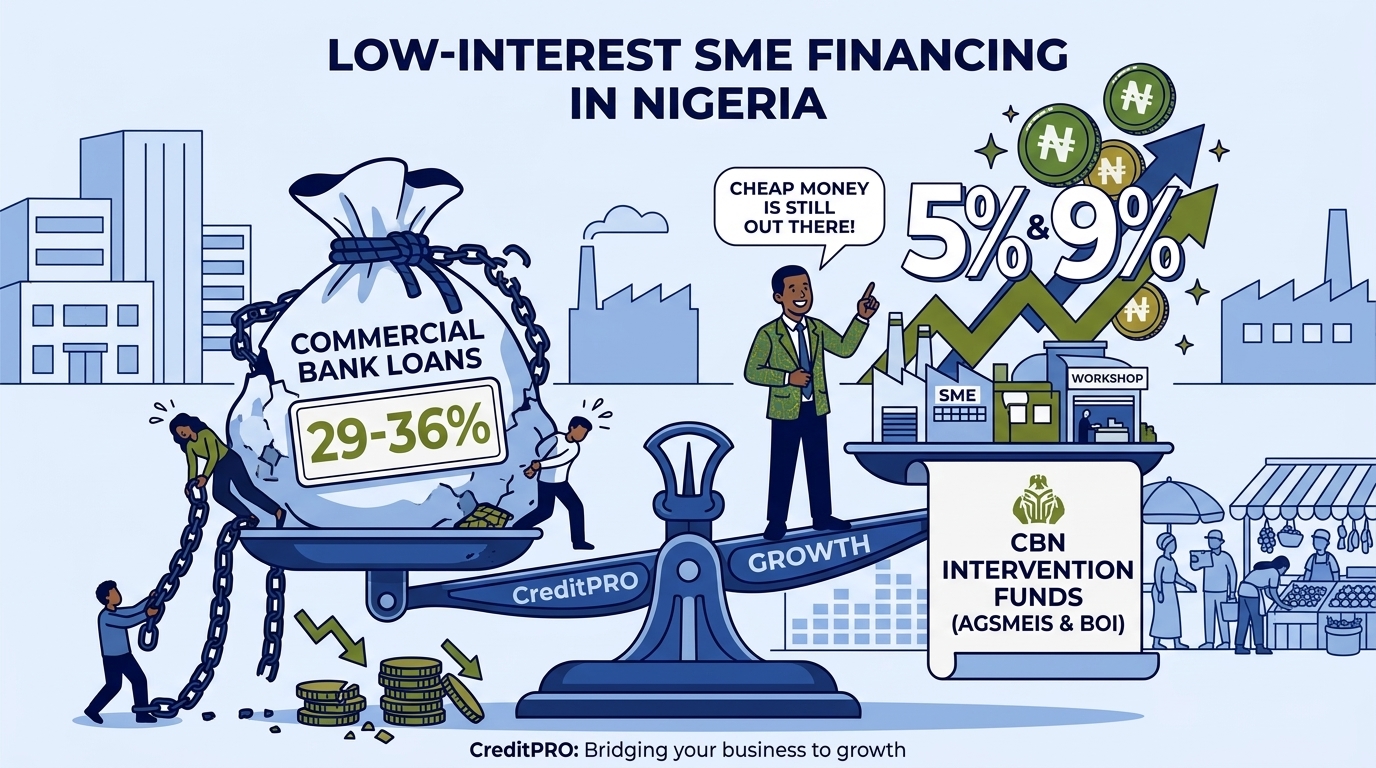
With Nigeria’s benchmark interest rate held at 26.5% and commercial bank loans still costing SMEs between 29% and 36% a year, access to affordable credit remains one of the biggest constraints on small business growth.
Yet several concessionary financing windows remain open and underused: the ₦75billion FGN/Bank of Industry (BOI) MSME intervention fund at 9% per annum, the AGSMEIS scheme at 5% per annum with no collateral, and private-sector growth programmes like Paystack’s new Small Business Launchpad.
What Happened?
At its 306th meeting held on 20-21 July 2026, the Central Bank of Nigeria’s Monetary Policy Committee (MPC) voted to hold the benchmark Monetary Policy Rate (MPR) at 26.5%, continuing a tight monetary stance aimed at consolidating gains on inflation and foreign exchange stability.
While the next MPC meeting is scheduled for 21-22 September 2026, the practical effect for business owners on the just concluded MPC meeting is that commercial bank lending rates to SMEs remain elevated, commonly ranging between 29% and 36% per annum.
Against that backdrop, several concessionary funding channels remain open through 2026: the BOI/Federal Government of Nigeria (FGN) ₦75 billion MSME intervention fund, offering subsidised loans at 9% per annum for manufacturing and agro processing businesses; the Agri-Business/Small and Medium Enterprises Investment Scheme (AGSMEIS), offering up to ₦3 million at 5% per annum with no collateral; and the longer-runningMicro, Small and Medium Enterprises Development Fund (MSMEDF), administered through participating financial institutions.
The private sector is also stepping in. Paystack recently launched a “Small Business Launchpad,” a four week programme combining business clinics, mentorship, and up to three months of free payment processing (capped at ₦25 million in processed value) for selected merchants, with its first cohort of 50 businesses beginning 27 August 2026.
Why This Matters
The interest rate gap is not abstract. On a ₦2 million working capital loan, a commercial rate of roughly 32% costs about ₦640,000 in interest over a year; the same loan under AGSMEIS at 5% costs roughly ₦100,000. That difference is often what separates a business that can absorb one slow month from one that can’t.
Many eligible SMEs simply don’t know these schemes exist, or wrongly assume they are reserved for large manufacturers. In reality, MSMEDF and AGSMEIS are specifically designed for micro and small businesses, including services, ICT, and creative businesses, not just agriculture and manufacturing.
Growth support, not just cheaper capital, matters too. Programmes that bundle mentorship, cost relief and structured business clinics (like Paystack’s Launchpad, or the mandatory entrepreneurship training built into AGSMEIS) address the operational gaps that cause many SMEs to struggle even after securing a loan.
What SMEs Should Do
A practical action plan for the next 30 days:
•Start with eligibility mapping. Match your business (sector, size, turnover) against each scheme.
AGSMEIS and MSMEDF favour agriculture, agro-processing, ICT/creative and other registered
MSMEs; the BOI/FGN ₦75bn fund currently emphasises manufacturing and agro-processing.
•Get your paperwork in order first: valid CAC registration, Tax Identification Number (TIN), up-to
date director records, and basic financial statements or bank statements. Lenders and
participating institutions will ask for these early, and incomplete documentation is the most common reason applications stall.
•For AGSMEIS: create an account at agsmeisapp.nmfb.com.ng, complete the mandatory training at a CBN-approved Enterprise Development Institute (EDI), and prepare a clear, realistic business plan. No collateral and no application fee are required; be wary of anyone who asks you to pay to “fast-track” your application.
•For the BOI/FGN ₦75bn fund and MSMEDF: apply through a Participating Financial Institution (PFI), commercial bank, or microfinance bank, or check current guidelines at boi.ng or cbn.gov.ng. PFIs appraise economic and financial viability before forwarding applications, so a clean, coherent business case matters.
•For private growth programmes like Paystack’s Launchpad: watch official channels for the next cohort announcement, and budget for any participation fee against the value of the mentorship and processing relief on offer.
•Build a relationship with a financial partner (such as CreditPRO) before you urgently need funds. Lenders move faster for businesses with an existing track record and clean documentation than for first-time, cold applicants.
Risks to Watch
•”No collateral” doesn’t mean no scrutiny. You’ll still need guarantors, verifiable records, and a credible business plan. Weak documentation is the single biggest reason applications stall.
•Processing timelines for intervention funds can run longer than commercial loans. Don’t apply the week you need cash; apply ahead of your funding need.
•Beware of intermediaries or “agents” demanding upfront fees to guarantee approval for AGSMEIS, MSMEDF, or other CBN-linked funds. The CBN does not charge application fees for these schemes.
•Sector and size eligibility can vary by fund and can be revised without much notice. Always verify current guidelines directly from CBN, BOI, or NMFB rather than relying on older blog posts or agents.
•Concessionary funds are typically capped (₦3 million under AGSMEIS, for example), so larger capital needs will still require a blend of intervention funding and commercial or specialised SME financing.
Opportunities
Interest savings freed up from concessionary funding can be redirected into inventory, hiring, or marketing, effectively compounding growth rather than just servicing debt.
Programmes that combine capital with capacity-building (such as the Paystack Launchpad, or the mandatory EDI training under AGSMEIS) build management skills that make your business more resilient, and more fundable, the next time you seek financing.
Repayment behaviour is becoming a bigger factor in access to credit. Recent industry reporting has highlighted notably lower default rates among female-led businesses, a reminder that a strong repayment history, not just collateral, increasingly shapes future lending decisions.
Businesses that can’t access, or don’t fit, intervention fund criteria still have options. Tailored SME facilities from finance companies like CreditPRO can bridge working capital gaps or complement intervention funding while an application is being processed.
CreditPRO Insight
Intervention funds are valuable, but they are not always fast, and they don’t fit every business model or funding need. At CreditPRO, we regularly work with SMEs who pair a CBN-linked facility for long-term, lower-cost capital with a complementary CreditPRO working capital or asset finance facility to bridge timing gaps or cover needs outside a scheme’s sector focus. The businesses that grow fastest tend to treat financing as a portfolio, not a single application, and they start building a relationship with a lender well before the funding gap becomes urgent.
Final Thoughts
Nigeria’s high interest rate environment isn’t easing immediately, but it isn’t the whole story either.
Concessionary windows like AGSMEIS and the CBN/BOI ₦75 billion fund, alongside newer private-sector growth programmes, mean the cost of capital doesn’t have to sink your margins. The businesses that benefit most are the ones that prepare their documentation early, apply before they’re desperate, and treat every funding conversation (public or private) as a chance to build a longer-term relationship with a financial partner.

About the Author
Anthony Jiboye is the Head of Growth and Customer Experience at CreditPRO Finance Company Limited. With a proven track record in driving business expansion, customer retention strategies, and service excellence, Anthony leads CreditPRO’s growth initiatives to deliver seamless, customer-centric financial solutions. He is passionate about scaling innovative financial products, enhancing user journeys, and empowering businesses across Nigeria to access reliable funding and growth opportunities.