- October 11, 2026

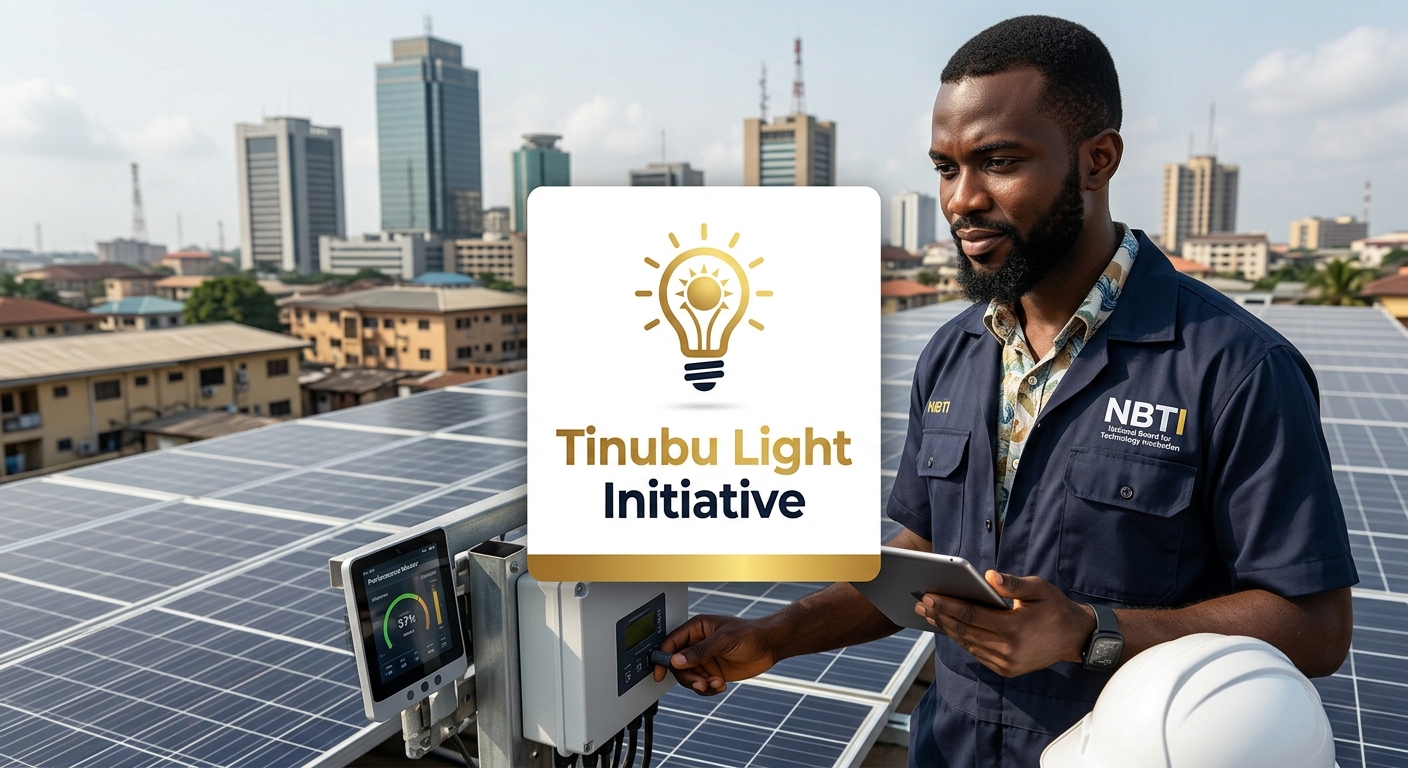
Tinubu Light: Can Renewable Energy Finally Reduce Nigeria’s SME Energy Burden?
Nigeria’s SMEs have long faced a double challenge which is growing their businesses while coping with unreliable and expensive electricity. The Federal Government’s Tinubu Light Initiative (TLI), reportedly targeting affordable renewable energy solutions for one million MSMEs and more than 50,000 direct jobs, could therefore be more than an energy intervention it could become an important SME productivity and financing initiative.
The News: What the Initiative Means
On Thursday, August 6, 2026, the Federal Government, through the National Board for Technology Incubation (NBTI), officially unveiled the Tinubu Light Initiative at the NICON Luxury Hotel in Abuja. Launched during the National Showcase of the NextGen Innovation Challenge 2026, the initiative is aimed at expanding access to affordable renewable energy for Micro, Small, and Medium Enterprises (MSMEs) across Nigeria. This comes against the backdrop of Nigeria’s persistent electricity access and reliability challenge.
The Tinubu Light Initiative will operate through four broad mechanisms:
•Innovative financing models — rather than simply giving businesses solar equipment for free, financing structures would be placed, intended to make renewable-energy solutions affordable for MSMEs.
•Strategic partnerships — the National Board for Technology Incubation (NBTI) says the programme will work with relevant public- and private-sector partners to achieve nationwide deployment.
•Renewable-energy technologies — the programme is intended to deploy clean-energy solutions to businesses, helping them reduce their dependence on expensive petrol and diesel generators.
•Digital financing and local production — the announcement also says the initiative will support local assembly and production of renewable-energy equipment and expand access to digital financing, with particular opportunities for women and young entrepreneurs.
So, what does that mean practically?
The model appears to be less about government simply “giving one million SMEs solar panels” and more about creating an ecosystem where renewable-energy providers, financing institutions and government programmes work together to make energy systems accessible to MSMEs.
Why This Matters More Than an Electricity Story
Energy from a business finance perspective is not simply an infrastructure problem but is a cash flow problem.
Electricity expenditure for SMEs in Nigeria affects virtually every part of the income statement. A bakery needs power for production, a cold chain operator needs uninterrupted electricity to protect inventory, a restaurant needs refrigeration and cooking equipment, a manufacturer needs predictable power to keep machinery operating. Even a small retail business increasingly depends on electricity for point of sale terminals, refrigeration, internet connectivity and digital payments.
When grid electricity becomes unreliable then businesses compensate with generators, petrol, diesel and alternative energy systems. The result is higher operating expenditure and reduced margins. This is why the Tinubu Light Initiative should be viewed through a wider economic lens as reliable energy can translate into lower operating costs, stronger cash flows, higher productivity and ultimately greater capacity to repay financing.
The Real Opportunity for Nigerian SMEs
The biggest opportunity is not the distribution of solar panels, batteries or other renewable energy equipment, rather, the bigger opportunity is the possibility of changing the economics of running a small business. Consider an SME that spends a substantial portion of its monthly revenue on diesel and petrol. If renewable energy reduces that expenditure, the resulting savings can be redirected toward inventory, employee salaries, technology, marketing, equipment acquisition and business expansion. In other words, energy affordability can strengthen the financial health of an SMEs even when the intervention itself is not a conventional financing programme.
This creates what I would describe as an energy to finance multiplier effect.
Final Thoughts
Strategically, the Tinubu Light Initiative is well directed. However, implementation will determine the programme’s success. Government should measure more than the number of solar systems distributed. The critical indicators for the success of the initiative should include reductions in energy costs, increased revenues, productivity improvements, employment creation, business survival and improved access to finance. Energy solutions should also be tailored to different businesses because the needs of a retailer are very different from those of a bakery, welding workshop or manufacturer.
Nigeria does not only need more SME financing but it also needs to reduce the structural costs that make businesses financially vulnerable.
The real question is not whether one million SMEs can be powered.
The real question is whether one million businesses can become more productive, profitable and financeable because they are powered.

About the Author
Dr. Ozemoya Osikpemhi Amos Onoshoze Pedro is an accounting and finance scholar, researcher, and professional with over a decade of industry experience. Holding a Ph.D. in Accounting and Finance, his expertise spans corporate finance, strategic management, governance, and business innovation. He is passionate about producing research that bridges academic theory with practical business solutions, helping organizations achieve sustainable growth and financial excellence. You can reach him on LinkedIn