- October 11, 2026

MTN ICT+ Business Skills Training Programme 2026: A Business Growth Opportunity for Women-Owned SMEs in Nigeria
For thousands of young Nigerian women running small businesses, the biggest challenge is no longer simply starting a business rather it is acquiring the digital, managerial and operational capabilities required to survive and grow in an increasingly competitive market.
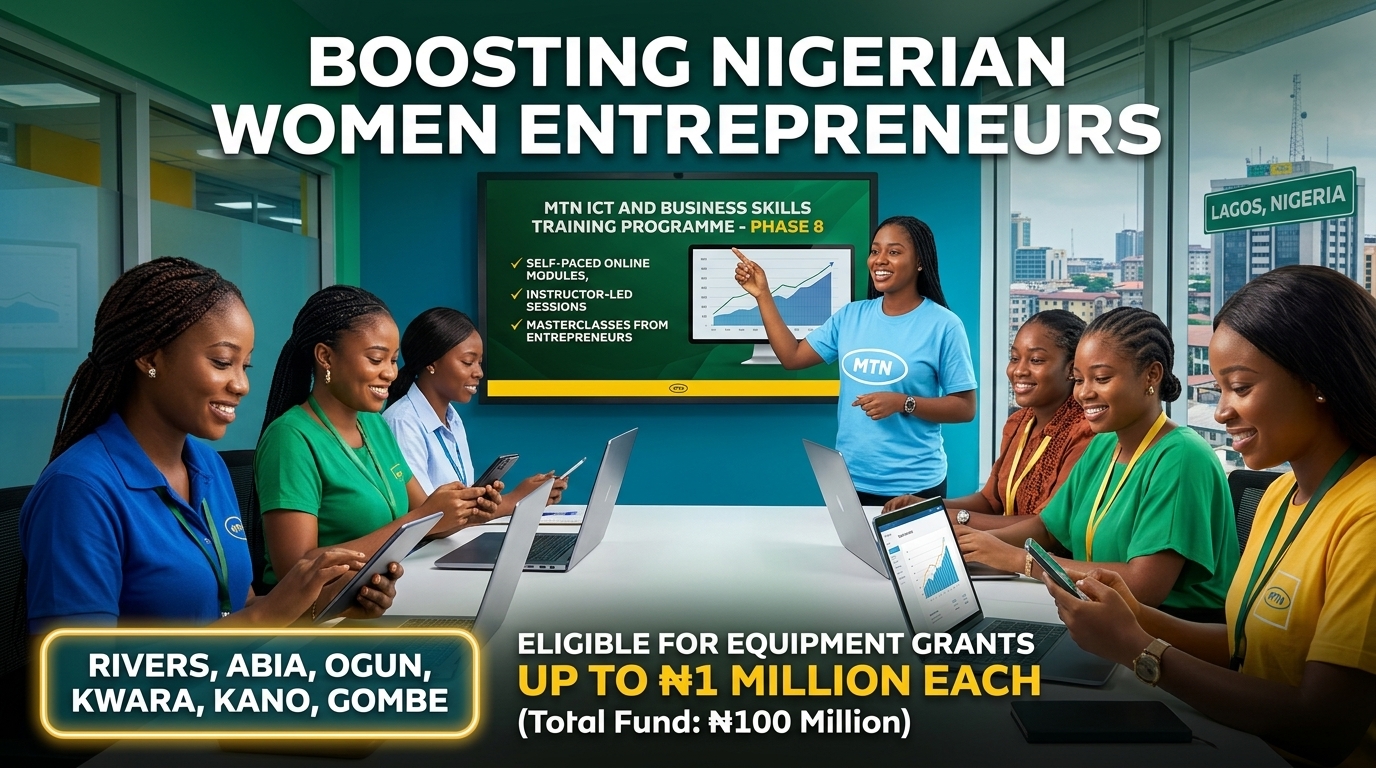
The MTN ICT and Business Skills Training Programme – Phase 8 is offering 3,000 young female microbusiness owners an opportunity to strengthen those capabilities through a five week training programme with the top 100 participants eligible for equipment grants of up to ₦1 million each.
The programme is targeted at women aged 18–35 who own and manage microbusinesses that have been operating for not more than two years. Eligible businesses must be located in Rivers, Abia, Ogun, Kwara, Kano and Gombe State. Applications are currently open and close on 11 October 2026.
What Does the Programme Offer?
Phase 8 will run for five weeks using a blended learning model comprising self-paced online modules, instructor led sessions, master classes from experienced entrepreneurs and a capstone project and participants will also receive data support during the programme.
More importantly the programme goes beyond training and the top 100 participants will be eligible for equipment grants of up to ₦1 million each thereby representing a total equipment grant fund of ₦100 million.
The programme has also built a significant track record since its inception in 2018, MTN Foundation says 15,362 young Nigerian microbusiness owners have completed the programme.
From a business development perspective, the most important aspect of this initiative is not the potential ₦1 million equipment grant but it is the combination of business skills, digital capability and productive assets as many microbusinesses in Nigeria struggle not because there is no market for their products but because the owners lack the systems required to convert market opportunities into sustainable revenue. Weak bookkeeping, limited digital marketing, poor customer management, inadequate pricing, low inventory visibility and the absence of reliable business data can restrict growth even when demand exists.
This is particularly important in an economy where digital transformation is becoming increasingly central to competitiveness. PwC’s MSME Survey in 2024 notes that MSMEs in Nigeria account for 46.32% of GDP also 87.9% of employment and 96.9% of businesses while identifying digital and technology transformation as an important factor in improving MSME productivity and profitability.
The MTN programme therefore addresses a critical problem which is capital without capability does not necessarily create sustainable businesses because take for example a business owner who receives ₦1 million but does not know how to manage cash flow, acquire customers, price products, maintain records or use digital channels effectively can quickly consume the money without achieving meaningful expansion.
Conversely, an entrepreneur who combines training with disciplined financial management and a clear growth strategy can potentially turn relatively modest productive assets into additional revenue and employment.
What Does This Mean for SMEs in Nigeria?
The programme demonstrates an increasingly important direction in SME development since finance and skills are becoming complementary rather than competing interventions.
Digital competence for SMEs in Nigeria can improve customer acquisition through social media and online marketplaces, facilitate electronic payments, strengthen customer records, improve communication and enable entrepreneurs to make decisions using actual business data rather than assumptions.
The programme also reinforces the importance of formalizing and documenting a business because entrepreneurs seeking grants, equipment support or commercial financing increasingly need to demonstrate what their businesses do, how they generate revenue, who their customers are and how additional capital will improve performance.
This initiative will also expand digital SME support which means reflecting a broader movement toward using digital platforms to connect businesses with information, markets and financing opportunities and for SMEs the lesson is straightforward which is do not prepare for funding only when an opportunity is announced but build a finance ready business continuously.
Opportunities such as the MTN ICT and business skills training programme are valuable but entrepreneurs should not build their businesses around grants alone because grants can accelerate a business but systems sustain it.
Entrepreneurs in Nigeria should therefore focus simultaneously on digital skills, proper bookkeeping, customer management, business formalization, cash flow discipline and access to appropriate financing.
Not every growing business will win a grant or competition and this makes private sector financing and a strong credit profile increasingly important for SMEs that need working capital, equipment or expansion funding.
The smartest entrepreneur is therefore not the one who waits for an opportunity to appear but one who builds a business that is ready when the opportunity arrives.
What Should Entrepreneurs Do Now?
Eligible entrepreneurs should first confirm that they satisfy the programme’s basic requirements: they must be women in Nigeria aged 18–35, own and manage a microbusiness that has operated for no more than two years and have the business located in Rivers, Abia, Ogun, Kwara, Kano or Gombe State.
Applicants should then prepare accurate information about their business, including what the business does, its operating history, customers, products or services, current activities and growth potential.
Entrepreneurs should also think carefully about what they would do with the equipment support if selected. A strong business case should be able to answer a simple question: How will this equipment increase my business revenue, capacity, efficiency or profitability?
For example, a fashion business may require an industrial sewing machine; a food business may need processing or packaging equipment; a digital service business may require a computer; while a beauty business may need productive equipment that enables it to serve more customers.
The objective should not simply be to acquire an asset rather the objective should be to acquire an asset that generates additional income.
How to Apply
Step 1: Confirm that you meet the eligibility requirements.
Step 2: Visit the official MTN Foundation Phase 8 application page (https://mtnictandbusinessskills.mtn.ng/mtn-foundation).
Step 3: Read the Terms & Conditions and the MTNF Data Privacy Notice. Tick the box to accept the Terms & Conditions and acknowledge the MTNF Data Privacy Notice
Step 4: Complete the application form with accurate personal and business information.
Step 5: Review your application carefully before submitting it.
Step 6: If selected, commit fully to the five week training programme, including the online modules, instructor-led sessions, masterclasses and capstone project.
Application deadline: 11 October 2026.
Apply here: https://mtnictandbusinessskills.mtn.ng/mtn-foundation

About the Author
Dr. Ozemoya Osikpemhi Amos Onoshoze Pedro is an accounting and finance scholar, researcher, and professional with over a decade of industry experience. Holding a Ph.D. in Accounting and Finance, his expertise spans corporate finance, strategic management, governance, and business innovation. He is passionate about producing research that bridges academic theory with practical business solutions, helping organizations achieve sustainable growth and financial excellence. You can reach him on LinkedIn