- October 11, 2026

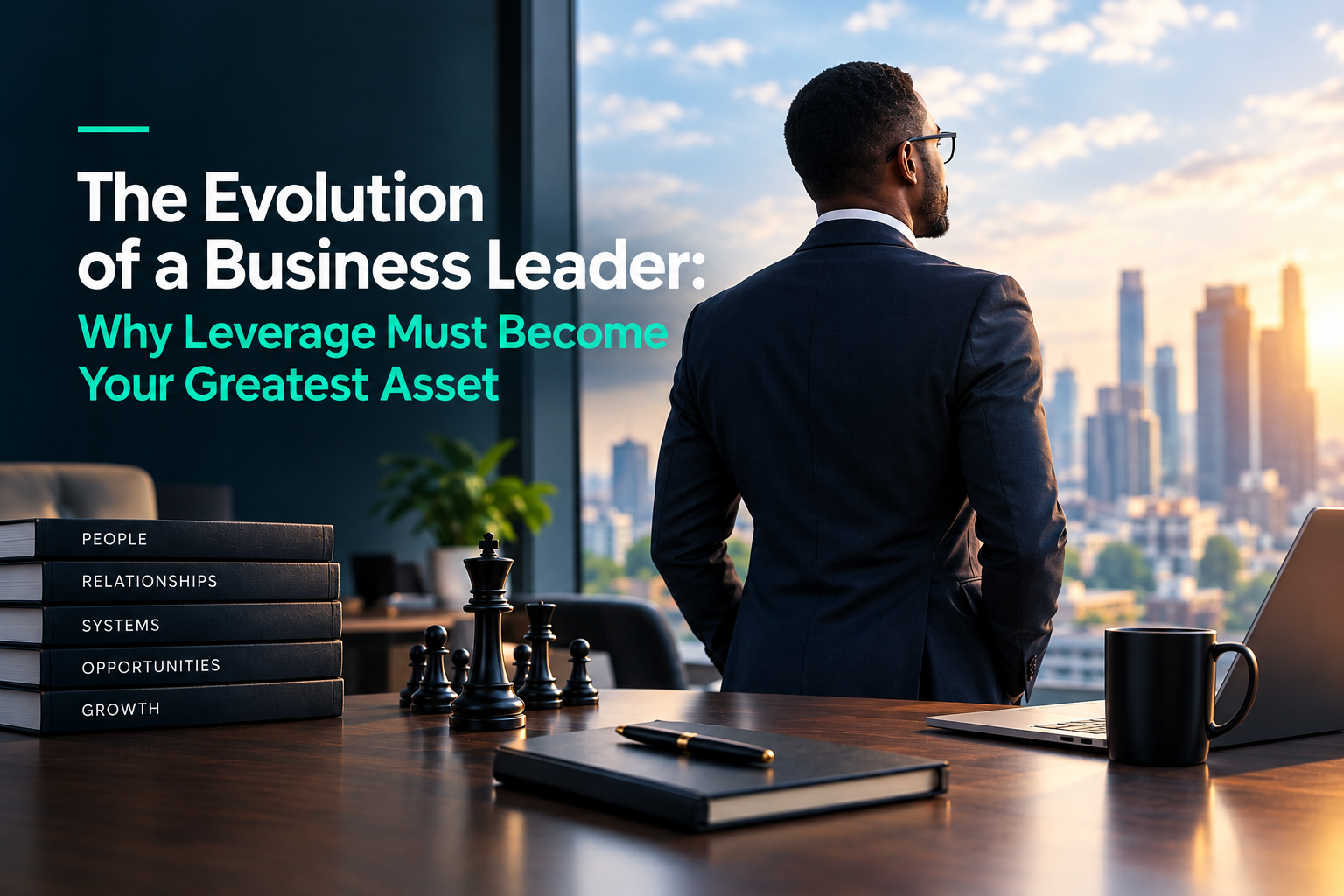
As I grow in business, I have come to appreciate an important lesson: the role of a business leader must evolve as the business grows.
In the early stages of a business, success often depends on personal effort. You are involved in almost everything including finding customers, negotiating deals, managing people, solving operational problems and ensuring that things get done. Your ability to work hard, make decisions and personally drive results is essential.
However, as the business grows, a point comes when personal effort alone is no longer enough. Opportunities become bigger, responsibilities increase, and the demands on your time multiply.
At this stage, I believe business leaders must make a deliberate transition. They must move from doing everything themselves to achieving results by leveraging people, relationships, systems and other resources.
The question gradually changes from “What can I do?” to “What can I make happen?”
This, in my view, is one of the most important transitions in the journey of a business leader.
Understanding Leverage in Business
When people hear the word leverage, they often think of borrowing money to finance a business. While financial leverage is important, the concept is much broader.
Leverage is the ability to achieve greater results by effectively mobilizing resources beyond your personal time, effort and capacity.
It means using relationships to access opportunities, engaging the right people to execute your vision, building systems that improve efficiency, deploying technology to increase productivity, and forming partnerships that enable your business to accomplish more than it could independently.
A business leader who understands leverage recognizes that growth does not necessarily require doing more personally. Sometimes, growth comes from learning how to mobilize the right resources to achieve more.
The ability to do the work may help you build a business, but the ability to organize others to do the work may be what enables you to scale it.
1. Leverage Through People
No business leader can achieve sustainable growth by relying entirely on personal effort.
At some point, you must build a team of people who possess the skills, experience and capacity to deliver results. This requires more than recruitment. It involves identifying people’s strengths, assigning responsibilities, delegating authority, establishing accountability and creating an environment where people can perform.
Delegation is not an admission of weakness. It is a recognition that the business has grown beyond the capacity of one individual.
The leader’s responsibility is not to do everything but to ensure that the right things are done by the right people.
This also requires trust. If you delegate tasks but insist on controlling every decision, you may have transferred the work without transferring the responsibility to deliver results.
Business leaders must therefore learn to develop people, empower them and hold them accountable.
A leader’s effectiveness is not measured only by personal performance, but also by the capacity of the people and systems they build.
2. Leverage Through Relationships: my CreditPRO experience
Of all the forms of leverage, relationships have become particularly important in my own business journey.
I have increasingly realized that the ability to close a deal is not always about what you can personally provide. Sometimes, it is about the people you know, the trust you have built, the opportunities you can identify and your ability to connect the right parties.
One of the clearest examples of this in my business journey comes from CreditPRO.
One of our early investors, whom I will refer to as Mr. X, was my friend during primary and secondary school. After he relocated abroad, we lost contact for many years. We eventually reconnected through social media, and he expressed an interest in investing in CreditPRO.
That re-connection became the beginning of a relationship that has continued for over five years without disappointment. What makes this relationship particularly significant is that his contribution has extended beyond his personal investment. Mr. X has become an important source of investor referrals for CreditPRO, connecting us with members of the Nigerian community in Maryland, USA.
Many of these investors had no prior personal relationship with me. They came to know about CreditPRO through my friend, whose relationship with them helped establish an initial level of trust and confidence.
Think about it: I could spend years trying to establish personal relationships with prospective investors across the diaspora. Yet, through one trusted relationship, I have been connected to people and opportunities that might otherwise have remained beyond my immediate reach.
This is the power of relationship leverage: one trusted relationship can open doors to an entire network of opportunities.
This experience has reinforced an important lesson for me. The greatest value of a relationship may extend far beyond what the person directly brings to the table. It may lie in the wider network of trust, credibility, knowledge and opportunities that the relationship makes accessible.
However, relationships should not be viewed merely as a means of getting something from someone. Sustainable relationship leverage is built on trust, integrity, credibility and mutual value.
3. Leverage Through Systems and Technology
Relationships may create opportunities, and people may provide the capacity to execute them, but systems help ensure that results are consistent and sustainable.
Imagine a business where every decision depends on the owner’s presence, every process exists only in the owner’s memory, and every customer complaint must be resolved personally by the owner. Such a business may generate revenue, but its growth will eventually be constrained by the capacity of its founder.
Business leaders must therefore develop processes that allow the organization to function efficiently, even when they are not directly involved in every activity.
Technology can strengthen this capacity. Accounting software, customer relationship management systems, digital payment platforms, inventory management tools and artificial intelligence can improve productivity, enhance decision-making and reduce repetitive work.
But technology should support a sound process, not replace the need for one.
The objective is not simply to work harder or acquire more tools. It is to build a business that can achieve more with the resources available to it.
If every opportunity requires your personal involvement at every stage, you may be creating growth in revenue without building the capacity to sustain that growth.
4. Leverage Through Capital and Strategic Partnerships
Capital remains an important driver of business growth. The ability to access funding can help a business acquire assets, increase production, fulfill larger contracts or enter new markets.
However, financial leverage must be approached with discipline. Borrowing can magnify returns, but it can also magnify losses when the underlying business opportunity is poorly assessed.
Business leaders must understand the cost of capital, repayment obligations, cash-flow implications and risks before taking on debt.
Strategic partnerships can also provide access to resources, expertise, distribution channels, markets and capabilities that would be difficult or expensive to develop independently.
The important point is that you do not have to own every resource or possess every capability required for growth. Sometimes, the smarter approach is to collaborate with those who already have what you need.
Nevertheless, leverage without adequate structure can create confusion, unnecessary costs and risk. Before pursuing an opportunity, a business leader must consider whether the organization has the people, systems, financial discipline and governance required to deliver on its promises.
The objective is not to accumulate resources for their own sake, but to mobilize the right resources to achieve clearly defined business outcomes.
The Business Leader Must Evolve
As businesses grow, leaders must be willing to change how they contribute to the organization.
The entrepreneur who once succeeded through personal effort must become a leader who builds people and systems. The leader who once focused primarily on executing tasks must learn to identify opportunities, establish partnerships, mobilize resources and position the business for sustainable growth.
This does not mean becoming detached from the business or abandoning operational responsibility. It means directing personal attention towards activities where the leader can create the greatest value.
Business leaders should continually ask themselves:
These questions help distinguish a leader who is simply busy from one who is deliberately building an organization.
Ultimately, the goal is not to make yourself unnecessary to the vision. It is to make yourself less necessary to the daily operations so that you can focus on shaping the vision, building capacity and creating new opportunities.
As a business leader, you must recognize that your greatest contribution may eventually shift from the tasks you personally complete to the opportunities you create, the people you empower and the resources you mobilize.

About the Author
Dr. Sola Adeyiga is the founder and CEO of CreditPRO Finance Company Ltd. He is a small business banking enthusiast, an expert in credit administration and an experienced entrepreneur. He has trained, coached and mentored various small business owners in Nigeria. You can reach him on www.linkedin.com/in/soladeyiga