- October 11, 2026

FG Launches New Initiative to Support Early-Stage Entrepreneurs with Training and ₦5 Million Funding
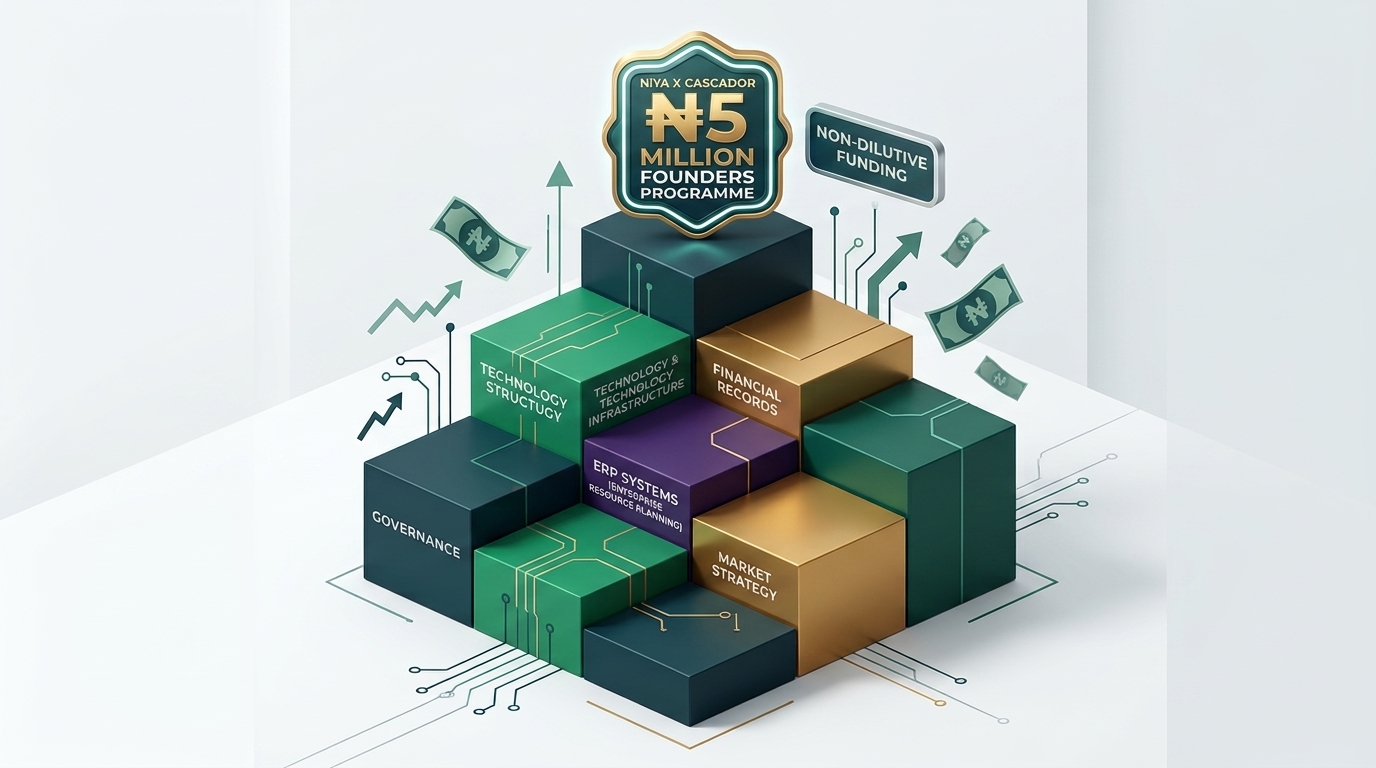
The Federal Government’s new NiYA × Cascador Founders Programme is one of the more interesting entrepreneurship interventions because it goes beyond the usual government model of simply distributing money. The pilot will select early stage Nigerian founders for four weeks of intensive training in business fundamentals, investment readiness, pitch preparation and mentorship. At the end, eight top performing founders will receive up to ₦5 million each in non-dilutive funding alongside an Enterprise Resource Planning (ERP) solution and because the funding is non-dilutive, successful founders will not be required to surrender equity in their businesses in exchange for the funding. The Minister of Youth Development, Ayodele Olawande, announced the programme on Facebook on 14 August 2026, saying it is designed to help young founders become investment ready and gain access to funding and applications are scheduled to open on 19 August 2026. (FMYD)
How to Apply
Applications for the NiYA × Cascador Founders Programme are now open. Interested Nigerian youth entrepreneurs can apply through the official NiYA website
WHAT IT MEANS FOR NIGERIAN ENTREPRENEURS
The significance of the programme becomes clearer when viewed against the scale of Nigeria’s SME economy. The most important aspect of this initiative from a professional business development perspective is not the ₦5 million itself but it is the combination of capital, capability and business structure. Many Nigerian entrepreneurs do not necessarily fail because their products have no market but they fail because the businesses lack proper financial records, pricing systems, inventory
controls, market strategy, governance, technology and the capacity to convert sales into sustainable profit. A programme that helps entrepreneurs become investment ready can address some of these weaknesses before capital is injected.
For a genuinely viable small business, ₦5 million can be transformational as it could finance additional production equipment, inventory, digital marketing, distribution, technology, staff recruitment, packaging, working capital or expansion into another market among others. For example, a food processing business could use the money to increase production capacity; a technology company could strengthen its product and customer acquisition; while a retail or manufacturing enterprise could use the funding to improve inventory and distribution.
However, I would caution entrepreneurs against viewing the programme primarily as a ₦5 million giveaway because such mindset could undermine its real value since the competition is really about demonstrating that a business is capable of converting additional resources into measurable growth.
This is where I believe the programme could have its greatest implication for SMEs in Nigeria as it could shift the conversation from “I need money for my business” to “I have a business model capable of generating returns and I can demonstrate exactly what additional capital will accomplish.” That is a significant change in entrepreneurial thinking.
While the programme can provide valuable grant funding but not every growing business will qualify for it. Therefore, access to appropriate private sector financing remains critical for SMEs that need working capital, equipment financing or expansion funding. The real opportunity is for entrepreneurs to build businesses that are strong enough to attract and responsibly utilize different forms of finance.
For entrepreneurs in Nigeria, the lesson is simple: don’t prepare only to apply for the ₦5 million but prepare to prove that your business can turn ₦5 million into ₦10 million, ₦20 million or ₦50 million in sustainable economic value.
Overall, this is a positive step if properly implemented and followed with post-training support as it could help move Nigeria’s entrepreneurship ecosystem from “empowerment” to genuine “enterprise” growth and job creation.

About the Author
Dr. Ozemoya Osikpemhi Amos Onoshoze Pedro is an accounting and finance scholar, researcher, and professional with over a decade of industry experience. Holding a Ph.D. in Accounting and Finance, his expertise spans corporate finance, strategic management, governance, and business innovation. He is passionate about producing research that bridges academic theory with practical business solutions, helping organizations achieve sustainable growth and financial excellence. You can reach him on LinkedIn