- October 11, 2026

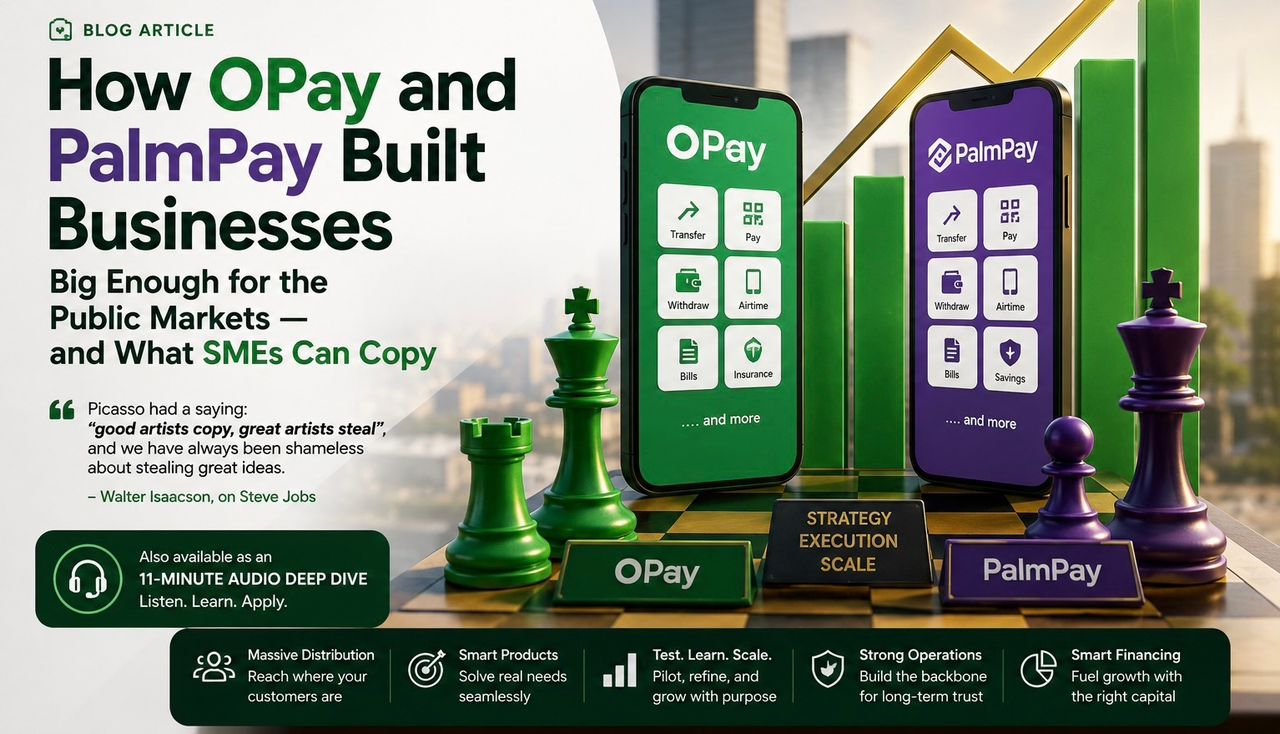
How OPay and PalmPay Built Businesses Big Enough for the Public Markets – and What SMEs Can Copy
Picasso had a saying: “good artists copy, great artists steal”, and we have always been shameless about stealing great ideas.
– Walter Isaacson, on Steve Jobs
Before you close this page to go report us: relax. Nobody at CreditPRO is telling you to sneak into your rival’s shop at night and copy their price list. We are a CBN-licensed finance company, not a getaway car service. What we are “stealing” here is much simpler, and completely legal: two Nigerian success stories that are worth studying closely. They just showed the whole country what “big dreams” can really look like.
Quick note before we go on: this article also comes with an 11-minute audio Deep Dive, the same ideas explored a little further, in an easy, relaxed conversation, like a good podcast. We’d genuinely encourage you to listen as well as read. It adds a layer of perspective the page alone doesn’t fully capture. Press play on the audio version at the top of this post, on a drive to work tomorrow or a walk in the evening.
OPay is preparing for a possible $4 billion US listing, and PalmPay is weighing a Hong Kong IPO of its own, two Nigerian fintechs edging toward the kind of public market attention few African-born businesses have reached. Nigeria alone accounts for 88.1% of OPay’s 2025 revenue, proof that this is a homegrown growth story before it is a global one.[1][4] Behind the funding headlines, both companies built their scale on a repeatable playbook: aggressive distribution, frictionless onboarding, diversified products, tested pilots, and deliberate financing. This article unpacks that playbook and shows Nigerian SME owners exactly which parts of it are copyable today, no billion-dollar valuation required.
Two Nigerian fintech companies have spent the past few months moving toward something no Nigerian consumer business has done at this scale before: preparing to sell shares to the public on a stock exchange, a move known as an IPO. An IPO is when a private company offers shares to the public for the first time, so that ordinary investors, not just founders and early backers, can buy a stake. Getting there is not automatic. It usually takes years of real financial performance, strong record-keeping, sound governance, and meeting the rules set by regulators and stock exchanges.
OPay is preparing for exactly that. Big banks, including Citigroup, Deutsche Bank, and JPMorgan, are helping plan a listing in the United States, targeting a company value of about $4 billion.[1] That is roughly double the $2 billion OPay was worth after its 2021 funding round, when it raised $400 million, and above the $3.1 billion value implied by a 2026 filing from Opera, an early OPay backer, which put the odds of an OPay IPO within two years at 85%.[2] In 2025, OPay’s revenue rose 161%, from $205.7 million to $536.3 million.[3] Its core business swung from a $35.1 million operating loss to a $107.1 million operating profit, and its final net profit for the year was about $72.5 million, up from a $50.98 million net loss in 2024.[3] Nigeria alone made up 88.1% of OPay’s total revenue in 2025, with Indonesia, Egypt, and other countries making up the small remainder.[4] OPay, in other words, is a Nigerian growth story wearing a global suit.
PalmPay is walking a similar path. It is reportedly seeking about $200 million in fresh funding ahead of a possible Hong Kong IPO that could value the company at more than $1 billion, though the amount, valuation, and listing plans could still change.[5][6] In 2026, PalmPay was named one of TIME magazine’s 100 Most Influential Companies in the World, and one of its 10 Most Influential Finance Companies of the year.[7][8] Its revenue grew at a compound annual growth rate of 583.6% between 2020 and 2023, according to the Financial Times’ 2025 ranking of Africa’s fastest-growing companies, where PalmPay placed second overall.[6]
Neither company got here by luck. Strip away the funding headlines and the IPO talk, and both companies really did a handful of things well, just at a giant scale, the kind most SMEs are still building toward. Understanding those mechanics matters, because they are transferable to a business of any size.
They mastered distribution before they chased scale. Neither company sat back and waited for people to trust a new app. OPay built a network of agents (regular people running small money points) that grew from fewer than 5,000 in late 2018 to more than 500,000 by 2023, making it the largest agent network of its kind in Nigeria at the time.[9] PalmPay has also built a huge distribution network of its own, with the company reporting more than one million agents and shops, though different reports use slightly different definitions of “agent.”[10] PalmPay also had a head start most competitors could only dream of: as part of a $40 million investment led by Transsion in 2019, the company’s app was pre-installed on 20 million Tecno, Infinix, and Itel phones in 2020 alone, brands with a dominant presence across African markets.[10] Distribution, in other words, was not a side detail. It was the growth engine.
They cut the friction of getting started. Instead of long forms, branch visits, and paperwork, both companies made signing up digital, fast, and open to people banks had usually ignored. That mattered enormously in a country where, according to TIME, more than a third of adults still lack a financial account of any kind. PalmPay alone has grown to more than 35 million registered users by reaching people traditional banking had left behind, not by fighting over the customers banks already had.[7]
They sold more than one thing. Payments got customers in the door. Then came savings, small loans, bill payments, and tools for shop owners. This is the real secret behind a “super app”: once you have a customer’s trust, you can offer them more than one useful thing instead of just one.
They proved it small before they scaled it big. Neither company walked in asking the market to believe in an idea. PalmPay quietly piloted its service from July 2019, first securing a mobile money licence from the CBN, then testing with real users, before it made any noise about funding. By the time it announced its $40 million round that November, the pilot had already handled 100,000 users and 1 million transactions.[11] OPay’s story rhymes at a different scale: it started quietly in August 2018, and only once its early model showed real traction did it raise $50 million, then $120 million, within six months of 2019, money that helped fund its climb to hundreds of thousands of agents.[12] Both companies showed proof first, and asked for money second.
They funded growth deliberately. OPay’s climb from a $2 billion valuation in 2021 to a $3.1 billion valuation implied by Opera’s 2026 filing, and now a $4 billion IPO target, did not happen by accident.[1][2] Here is the real lesson underneath those numbers: growth costs money before it makes money. If you win a bigger contract, buy new equipment, hire more staff, or open in a new location, the money usually has to go out first, before the extra sales come in. OPay and PalmPay planned for that. Most SMEs don’t, and that is exactly where things start to go wrong.
Here is the most important thing to understand before we go further: don’t copy their size, copy their discipline. OPay and PalmPay had access to the kind of institutional money most SMEs will never see, and that is not the lesson to take from their story. You should not go looking for a loan simply because a big company raised one. The real lesson is matching financing to a clear, specific need: working capital for a confirmed cash flow gap, asset finance for equipment that will earn its keep, and contract or supply-chain finance when a real order is waiting to be fulfilled.
With that in mind, here is how those lessons scale down to any size of business.
Master distribution before you chase customers. OPay and PalmPay did not wait for people to come looking for them. They went to markets, phone shops, and street corners where their customers already spent time, and made themselves impossible to miss. Most SMEs do the opposite. They open a shop or a page online and wait for people to arrive. Ask yourself where your customers already gather, a market, an estate, a church or mosque programme, another business’s foot traffic, and go stand there instead of waiting to be found.
Prove it small before you fund it big. Neither OPay nor PalmPay walked into an investor’s office with just an idea. They tested first, on a small scale, and let real results do the talking before asking for real money. Before you ask anyone to fund an expansion, run your own small test: a limited batch, one new location, or a short trial with a handful of customers. Keep it simple and track three things: what it cost you, what you earned, and whether those customers came back. That evidence is worth more than any business plan, and it is exactly what a lender wants to see before saying yes.
Fund the machine, don’t starve it. OPay and PalmPay never tried to build their agent networks using loose change and hope. They matched their big plans with real working capital, arranged early, before cash problems could turn into a crisis. Many Nigerian SMEs do the opposite. They wait until payday is close or stock has run out before they start looking for money, and by then, every option costs more and feels rushed. If growth is truly the plan, Working Capital Finance is there to fund the machine before it slows down, not to rescue it after it has already stopped.
Build capacity before you need it. Part of how OPay grew its agent network was simple: it invested in equipment, POS machines, systems, tools, before the demand arrived, not after. Many small businesses delay buying the equipment or vehicles that would let them handle more work, because the cost today feels bigger than the sales they are missing. Asset Finance exists for exactly this. It helps you build capacity, machines, delivery vehicles, production tools, without emptying the cash you still need to run your business today.
Turn credible contracts into growth. Every purchase order, supply agreement, or invoice you win can be an opportunity for growth, but only if you have the cash on hand to actually deliver it. Too many SMEs celebrate a big contract and then quietly struggle to fund it, because winning the order and having the working capital to fulfil it are two very different things. Supply Chain Finance helps turn credible, verifiable contracts into growth, unlocking the cash tied up in purchase orders and invoices, so a big order becomes fuel instead of a headache.
Know your numbers before you borrow. Neither OPay nor PalmPay is walking toward a public listing without knowing every number in their business by heart. That same habit is free for you to copy at any size. Before you take on financing to grow, work out what it will really cost, what the repayments look like next to your actual monthly income, and whether the timing is right. The Loan Calculator takes about five minutes and helps you work out what you can afford, before you sign anything, not after.
Reported IPO timelines, valuations, and fundraising amounts for both companies are still provisional and could change before anything is finalised. Treat them as direction, not certainty, and avoid basing your own financing decisions on someone else’s unconfirmed headline.[2][5]
Valuation is not the same as cash in hand. OPay’s climb in reported valuation, from $2 billion to $3.1 billion to a $4 billion target, reflects what investors believe the company could be worth, not money sitting in its account.[1][2] Do not confuse a big valuation number, yours or anyone else’s, with actual available cash.
Growing distribution or headcount faster than your unit economics can support is one of the fastest ways to turn ambition into a cash crisis. Both OPay and PalmPay paired their expansion with real fundraising and real proof of demand. Growth without that pairing usually ends in overdraft, not scale.
Borrowing to expand before you have tested demand, or before you know your real monthly repayment capacity, is how growth capital turns into distress instead of progress. This is exactly why proving your idea and knowing your numbers should come before any financing decision, not after.
Not every signed contract is automatically financeable. A purchase order or supply agreement is only as strong as the buyer’s credibility, the clarity of its terms, and your own capacity to deliver. Treat a big contract as an opportunity to prepare, not a guarantee of funding.
The more Nigerian fintechs like OPay and PalmPay draw serious global investor attention, the more that attention tends to spill over into broader confidence in Nigerian business models generally, not just fintech. That is good news for well-run SMEs in any sector.
SMEs that build the same habits now, clean digital records, a tested pilot, more than one revenue stream, and financing that matches a real need, are positioning themselves to be as “legible” to a lender as OPay and PalmPay have made themselves to Wall Street and Hong Kong investors. Legibility, not size, is what actually gets a business taken seriously.
None of the tools needed to start copying this playbook require a venture capital round. Working Capital Finance, Asset Finance, Supply Chain Finance, and the Loan Calculator are available to Nigerian SMEs today, at whatever size the business is right now.
At CreditPRO, we read stories like OPay’s and PalmPay’s the same way we read every other, for the discipline underneath the headline, not the headline itself. The businesses we back rarely raise hundreds of millions of dollars, and they don’t need to. What the strongest of our SME clients have in common with these two fintechs is smaller and more repeatable: they know where their customers are, they test before they commit, they keep clean numbers, and they borrow for a specific, provable reason rather than a general one.
If you are looking at your own business and wondering where to start, that is the honest answer: start with the discipline, not the size, and the financing conversation gets a lot easier. Our advisors are glad to have that conversation whenever you are ready, and the Loan Calculator is a good place to begin working out what you can afford.
Most SMEs are not trying to become a $4 billion company, and that was never really the point of this article. OPay and PalmPay do not prove that every business can go public. They prove something smaller and more useful: mastering distribution, making things easy for the customer, selling more than one thing well, proving an idea before funding it, and funding growth on purpose are not “big company” ideas. They are simply how growth works, at any size. They are just easier to see when the numbers get large enough to make the news.
Picasso, and Steve Jobs after him, were not really telling anyone to steal in the criminal sense. They were saying that good ideas deserve to be studied, learned from, and used somewhere new. OPay and PalmPay built their success in plain sight. The blueprint is right there for anyone to read. The only thing left to “steal” is a bit of your time to actually use it.
[1] PYMNTS, “Nigerian FinTech OPay Eyes $4 Billion Valuation for US IPO.” https://www.pymnts.com/news/investment-tracker/ipo/2026/softbank-backed-opay-eyes-4-billion-valuation-in-us-ipo/
[2] Launch Base Africa, “An 85% Chance of a $3.1bn IPO Within Two Years: Inside Opera’s High-Stakes OPay Bet,” April 24, 2026. https://launchbaseafrica.com/2026/04/24/an-85-chance-of-a-3-1bn-ipo-within-two-years-inside-operas-high-stakes-opay-bet/
[3] Nairametrics, “OPay swings to profit in FY2025 as revenue surges 161% to $536.3 million,” August 13, 2026. https://nairametrics.com/2026/08/13/opay-swings-to-profit-in-fy2025-as-revenue-surges-161-to-536-3-million/
[4] Brand Communicator, “Nigeria Accounts For 88.1% Of OPay’s Global Transaction Volume, Report Shows,” August 14, 2026. https://brandcom.ng/2026/08/14/nigeria-accounts-for-88-1-of-opays-global-transaction-volume-report-shows/
[5] Launch Base Africa, “Why African Fintech PalmPay Is Eyeing Hong Kong for a $1bn IPO,” August 5, 2026. https://launchbaseafrica.com/2026/08/05/palmpay-hong-kong/
[6] TechMoran, “PalmPay Eyes Hong Kong IPO as It Pursues Global Expansion,” August 6, 2026. https://techmoran.com/2026/08/06/palmpay-eyes-hong-kong-ipo-as-it-pursues-global-expansion/
[7] TIME, “PalmPay: 2026 TIME100 Most Influential Companies.” https://time.com/collection/time100-most-influential-companies/2026/palmpay/
[8] TIME, “The 10 Most Influential Finance Companies of 2026,” April 28, 2026. https://time.com/article/2026/04/28/time100-companies-finance/
[9] Technext24, “OPay and MoniePoint control 57.8% of 1.5 million POS agents in Nigeria,” June 27, 2023. https://technext24.com/2023/06/27/opay-moniepoint-pos-agents-nigeria/
[10] TechCabal, “Chinese-owned PalmPay and an aggressive growth strategy for Nigeria,” February 12, 2020. https://techcabal.com/2020/02/12/chinese-palmpay-nigeria-aggressive-growth/
[11] TechCrunch, “PalmPay launches in Nigeria on $40M round led by China’s Transsion,” November 12, 2019. https://techcrunch.com/2019/11/12/palmpay-launches-in-nigeria-on-40m-round-led-by-chinas-transsion
[12] World Economic Forum, “OPay: What is the record-breaking start-up?,” August 2021. https://www.weforum.org/stories/2021/08/opay-fintech-startup-africa-fastest-unicorn/

About the Author
Anthony Jiboye is the Head of Growth and Customer Experience at CreditPRO Finance Company Limited. With a proven track record in driving business expansion, customer retention strategies, and service excellence, Anthony leads CreditPRO’s growth initiatives to deliver seamless, customer-centric financial solutions. He is passionate about scaling innovative financial products, enhancing user journeys, and empowering businesses across Nigeria to access reliable funding and growth opportunities.