- October 11, 2026

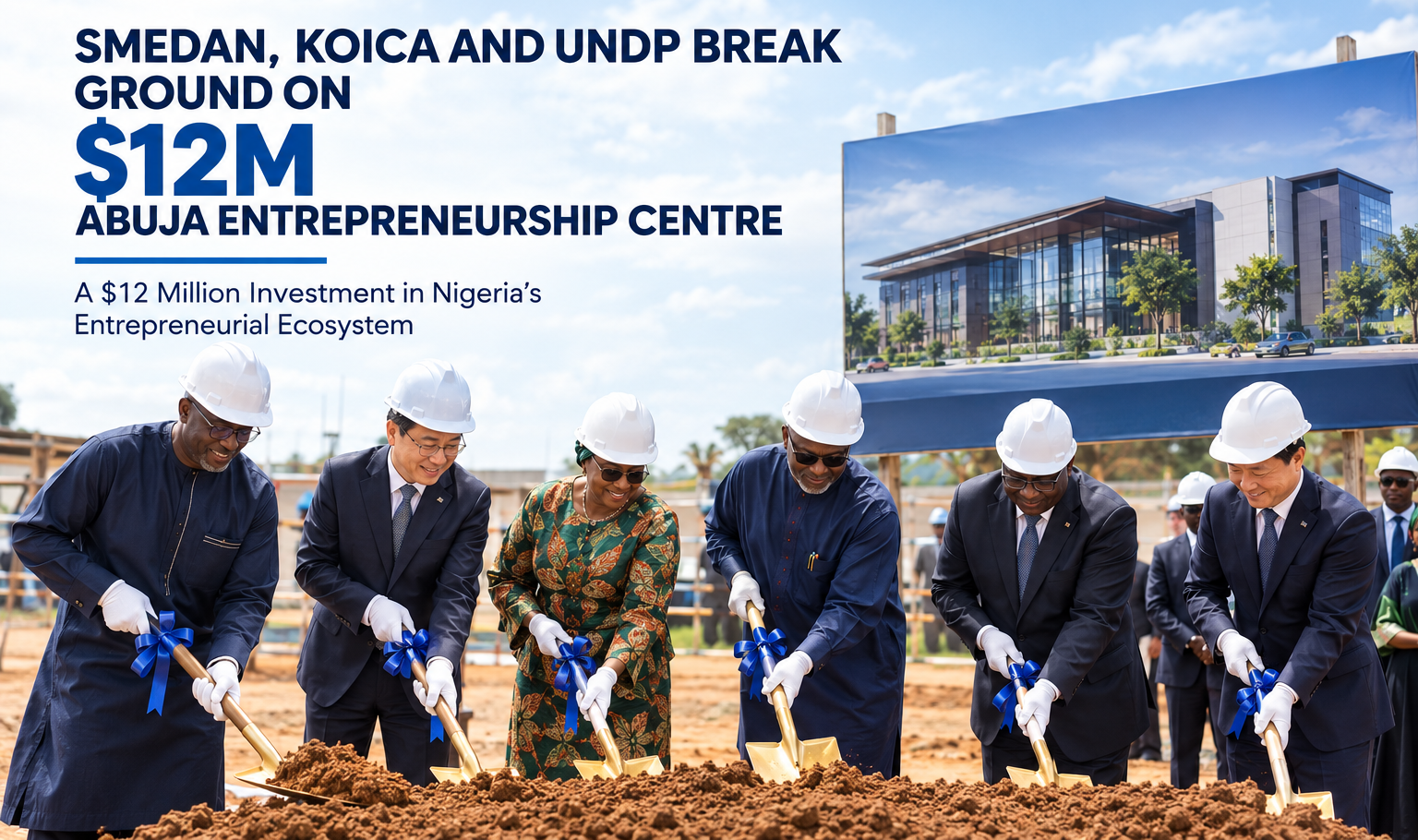
SMEDAN, KOICA AND UNDP BREAK GROUND ON $12M ABUJA ENTREPRENEURSHIP CENTRE
The Small and Medium Enterprises Development Agency of Nigeria (SMEDAN), the Republic of Korea through the Korea International Cooperation Agency (KOICA), and the United Nations Development Programme (UNDP) have commenced construction of the Abuja Centre for Entrepreneurship, backed by a $12 million Korean contribution. The groundbreaking ceremony took place at SMEDAN’s Industrial Development Centre in Idu, Abuja, on September 17, 2026.
The $12 million investment is structured to support both the development and operation of the centre, with approximately $5.9 million allocated to construction and $6.1 million dedicated to equipment and entrepreneurship programmes.
The centre is designed to provide training, incubation, co-working spaces, digital and technology support, specialist facilities, mentorship and enterprise development services. It has an initial target of supporting 500 entrepreneurs, 400 start-ups and 1,500 MSMEs, including businesses operating in areas such as FinTech, EdTech, HealthTech and AgriTech. It is also intended to support businesses beyond Abuja, strengthening entrepreneurship networks across surrounding northern cities.
Nigeria has a vast MSME ecosystem, yet access to finance and productive business support remain major constraints to enterprise growth. The World Bank reports that fewer than one in 20 Nigerian MSMEs has access to bank credit, highlighting the scale of the formal financing gap facing small businesses.
However, access to finance is only one part of the challenge. For many businesses, the ability to use capital effectively also depends on financial management, technology, operational systems, market access, skills and investment readiness. A business may have a viable product and still struggle to scale because it lacks adequate financial records, digital capabilities, production systems or access to the right networks.
This is where the Abuja Centre for Entrepreneurship could play a broader role. Rather than focusing only on entrepreneurship training, the centre is being designed around several components of enterprise development, bringing together training, incubation, workspaces, technology and connections to financial institutions, universities, incubators, private-sector organisations and entrepreneur networks.
The approach recognises that entrepreneurs often need more than capital to build sustainable businesses. A start-up may require technical support and mentorship, while an existing MSME may need better systems, technology, market connections or investment readiness before it can successfully access and deploy additional capital.
The project also builds on earlier SMEDAN–UNDP cooperation at the Idu facility. In February 2025, SMEDAN and UNDP launched a 120 KVA solar-powered mini-grid to improve reliable and affordable energy access for MSMEs, alongside plans for a state-of-theart makerspace focused on innovation, skills development and entrepreneurship.
The broader significance of the new centre, therefore, lies not simply in the construction of another entrepreneurship facility, but in the development of infrastructure and networks that can support businesses at different stages of their growth.
However, the ultimate measure of success should not be the completion of the building. It should be what happens to the businesses that pass through the centre: how many survive, scale, attract finance, improve productivity, enter new markets and create sustainable employment.
The Federal Government has said the centre is expected to become fully operational by December 2027.
For Nigerian entrepreneurs, the Abuja Centre for Entrepreneurship could create access to facilities and services that many businesses cannot afford to establish independently. These include professional workspaces, training infrastructure, incubation support, technologyenabled business services, mentorship and connections to organisations within the wider business ecosystem.
Its target of supporting 1,500 MSMEs alongside 500 entrepreneurs and 400 start-ups also indicates that the project is intended to serve businesses at different stages, from people developing entrepreneurial ideas to start-ups seeking to build viable businesses and existing MSMEs looking to strengthen and expand their operations.
The centre is also being designed with inclusion in mind, with accessible facilities for persons with disabilities and crèche services for women with young children. These features could help reduce some of the practical barriers that can limit participation in entrepreneurship programmes.
The wider implication is that Nigeria’s SME support ecosystem is increasingly moving beyond a simple “train and empower” model towards a more connected approach involving training, incubation, technology, finance, networks and business growth support.
This matters because finance remains one of the biggest barriers to enterprise expansion. The World Bank’s current financing programme for Nigerian MSMEs similarly recognises the need to combine access to capital with technical assistance and stronger financial systems. Its $500 million FINCLUDE project is designed to expand debt financing to 250,000 MSMEs while strengthening the capacity of financial institutions and improving lending processes.
For entrepreneurs, this means that being prepared for opportunities within an evolving support ecosystem will become increasingly important. Businesses should strengthen their financial records, business models, digital capabilities, governance structures, product quality and market strategies. These foundations can improve their ability to take advantage of financing, incubation, partnerships and market opportunities when they become available.
The $12 million Abuja Centre for Entrepreneurship represents more than a new building. It is an investment in the infrastructure, capabilities and networks required to help entrepreneurial ideas develop into commercially viable businesses.
Its potential impact will depend not only on whether the centre is completed and equipped, but on how effectively entrepreneurs are connected to the resources they need after entering the facility.
That means measuring outcomes beyond the number of people trained or businesses admitted. Over time, the centre’s impact could be reflected in the number of businesses that remain operational, attract investment or financing, increase productivity, enter new markets, adopt new technologies and create sustainable jobs.
The real success of the Abuja Centre for Entrepreneurship will ultimately be measured by the businesses it helps build and the extent to which those businesses are able to survive, grow and contribute to Nigeria’s wider economic development.

About the Author
Dr. Ozemoya Osikpemhi Amos Onoshoze Pedro is an accounting and finance scholar, researcher, and professional with over a decade of industry experience. Holding a Ph.D. in Accounting and Finance, his expertise spans corporate finance, strategic management, governance, and business innovation. He is passionate about producing research that bridges academic theory with practical business solutions, helping organizations achieve sustainable growth and financial excellence. You can reach him on LinkedIn