- October 11, 2026

AI Won’t Replace Your Employees. But an SME Using AI May Replace an SME That Doesn’t.
Quick note before we dive in: This article also comes with an audio Deep Dive, where we take the conversation a little further, exploring why 88% of Nigerians use AI personally while fewer than 1 in 10 SMEs actually use it for business, the practical difference between chasing flashy AI tools versus solving real business bottlenecks, and how small teams can multiply their productivity without a tech background or big budget. It’s an easy, relaxed listen that adds another layer of perspective on using AI to build a more competitive business.
Executive Summary
For years, the dominant question about artificial intelligence has been whether it will take people’s jobs. For Nigerian SME owners, a more useful question is what happens if a competitor learns to use AI better than you do. Nigeria’s National Artificial Intelligence Strategy recognizes AI’s potential to reshape productivity, jobs and economic competitiveness 1, and on the ground, Nigerian SMEs are already living that shift: widespread personal use of AI chat-bots has not yet translated into business transformation, and the gap between businesses that have started and businesses that haven’t is becoming a real competitive divide. This article looks at what is really happening, why it matters, and how to start closing the gap without a tech team or a big budget.
88% of Nigerian adults have used an AI chat-bot. Fewer than 1 in 10 Nigerian SMEs have actually put AI to work inside their business. That gap is not a curiosity. It is where your next competitor is quietly being built.
For years, one question has dominated conversations about artificial intelligence: will AI take our jobs? It is an understandable concern. But for business owners, there may be another question that deserves even more attention: what happens if your competitor learns to use AI much better than you do?
The competitive threat may not be that an AI system replaces your employee. It may be that another business uses AI to make its employees faster, its customer service more responsive, its marketing more effective and its operations more efficient. Over time, those small differences can become a very big competitive advantage.
For Nigerian SMEs, AI is moving beyond being a technology conversation. It is becoming a business-strategy conversation. The question is no longer simply “will AI replace people?” It is: how can we use AI to make our people and our business more capable?
Nigeria’s relationship with AI is a study in contrasts. On the consumer side, adoption has exploded: a 2025 Google-Ipsos study found that 88% of Nigerian adults had used an AI chat-bot, an 18-point increase in a single year and far above the 62% global average, with 91% of Nigerians using AI tools for work-related tasks and 80% exploring AI for new business ideas, nearly double the 42% global figure 2. Separately, industry researchers report that 64% of African workers are already actively using AI at work in some form 3.
But personal familiarity with AI has not translated into business transformation. Research on African SMEs found that only about 9% of Nigerian and South African SMEs have actually embedded AI into daily operations, strategy, or decision-making, while nearly 70% remain in the early stages of figuring out how to use it at all 4. The gap is sharpest by business size: roughly 75% of large firms have adopted AI in some meaningful way, compared to just 24% of firms with fewer than 10 employees 4. Yet the businesses that do implement AI successfully are seeing real results, an average of 2 to 4 hours saved weekly through automation of routine tasks 4.
75% vs 24%
Large Nigerian firms are adopting AI at roughly three times the rate of businesses with fewer than 10 employees. That is not a technology gap. It is a head start, and head starts compound.4
AI adoption is no longer simply a Silicon Valley conversation. The Enterprise Development Centre’s AI Readiness of Nigerian SMEs study, developed with eTranzact and launched in August 2025, surveyed 5,290 SMEs across all 36 states and the FCT, alongside focus groups with 212 participants, covering a sector of roughly 39 million Nigerian SMEs and MSMEs 5. It found “evident enthusiasm for AI among SME entrepreneurs,” alongside “critical gaps in awareness, access, and tailored solutions necessary to harness AI’s full potential” 5.
That gap represents both a challenge and an opportunity. Many businesses know AI is important. Fewer have figured out exactly how to integrate it into their operations. That creates an opening for SMEs willing to experiment intelligently, not by adopting every new AI tool, but by identifying the processes where AI can create measurable value.
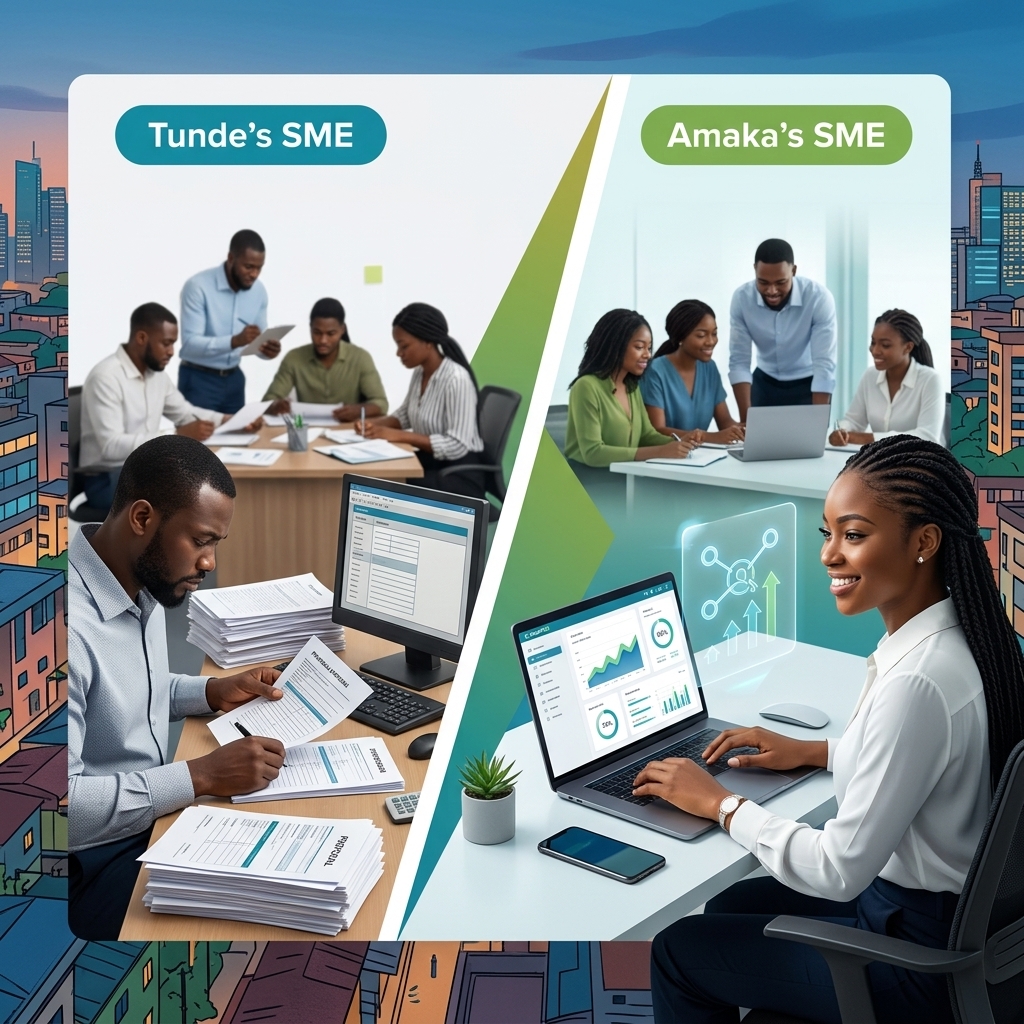
Picture two distribution businesses in the same Lagos market, competing for the same customers. Both have five employees. Both sell similar products. Both have similar levels of funding. Call the owners Amaka and Tunde.
Amaka uses AI to draft proposals, analyze customer enquiries, prepare sales follow-ups, summarise meetings, create first drafts of marketing content, analyze sales data, prepare management reports, organize internal knowledge, and automate repetitive administrative work. Tunde performs most of these activities manually, the way both of them did five years ago.
Amaka has not necessarily replaced anybody. She has simply given her five employees more leverage. That is perhaps the most useful way for an SME to think about AI: it can become a force multiplier for human capability.
A small business owner today can access capabilities that previously required additional staff or external specialists. Need to research a new market, draft a proposal, brainstorm a marketing campaign, summarise a long document, identify trends in a spreadsheet, or prepare a management report? AI can help with a first draft or first pass on each of these.
This does not mean an AI system can replace an experienced consultant, accountant, marketer or manager. It means the cost and time required to perform certain tasks can potentially fall dramatically. For an SME operating with limited resources, that can be significant.
Back to Amaka and Tunde. Tunde takes a full day to respond to a customer enquiry; Amaka uses AI-assisted workflows and can prepare a response within minutes, subject to human review. Tunde prepares every quotation from scratch; Amaka uses structured templates and AI to prepare a first draft. Tunde waits until the end of the month to analyze his sales performance; Amaka receives regular management summaries. Tunde’s employees spend large portions of their day on repetitive administrative work; Amaka’s employees spend more time selling, solving customer problems and building relationships.
Neither of them necessarily has better employees. Neither necessarily has more money. But one of them has begun to organize people and technology differently. Over time, that difference can affect response time, cost, productivity, customer experience, sales conversion, management visibility, and ultimately profitability. That is why the more important question may not be “will AI replace my employees?” It may be: “will businesses using AI eventually outperform businesses that do not?” Six months from now, one of them will be the business the market talks about. The other will be wondering what happened.
Nigeria’s MSME sector is enormous, official data puts micro, small and medium enterprises at 96.9% of all businesses, contributing an estimated 46.32% of GDP and 87.9% of employment 6, which means this adoption gap isn’t a niche concern, it is playing out across nearly every corner of the economy.
One mistake businesses can make is starting with the technology: “we need to start using AI” sounds progressive, but it is not yet a strategy. A better question is: where is our business losing time, money or opportunities?
The principle is simple: do not start with “how can we use AI?” Start with “what business problem can AI help us solve?”
AI may change what employers expect from employees. Knowing how to perform a task manually may no longer be enough when technology can accelerate that task. Employees may increasingly need to know how to ask better questions, evaluate AI-generated information, verify outputs, use AI within company policies, identify where human judgment is required, and turn information into action. This does not mean every employee needs to become a programmer; it means AI literacy may increasingly become part of business literacy.
Before adopting AI across an organization, an SME should ask:
These questions may appear less exciting than talking about the latest AI model. But they are much more important, because AI is a tool, and the business still needs a foundation on which the tool can work.
AI adoption should not become another expense that management struggles to justify. Ask: how much time did we save? Did we reduce errors? Did response times or sales conversion improve? Did employees spend more time on valuable activities? If an AI tool costs ₦100,000 per month but saves 100 hours of employee time and helps generate additional revenue, that is a business case. If it costs ₦100,000 per month and nobody can explain what it is actually doing for the business, that is not transformation, it is simply another subscription.
AI can be remarkably capable, but it can also be wrong. It can misunderstand context, generate inaccurate information, make poor assumptions, or produce an answer that sounds convincing but is not appropriate for your particular business. SMEs should not simply hand important decisions over to AI. A useful operating model: AI generates. Human reviews. Business decides. This becomes especially important in financial decisions, customer matters, employment, contracts, compliance, credit, and other high-consequence decisions.
A business may have an inefficient process and decide to automate it with AI. But AI does not automatically fix a bad process, it can simply make the bad process faster. If customer complaints are poorly categorized, automating the categorization does not necessarily solve the customer-service problem. If your sales data is inaccurate, an AI dashboard may simply give you a sophisticated presentation of inaccurate information. That is why businesses should first establish good data, clear processes, defined responsibilities, strong controls and capable people. Then AI can add another layer of leverage.
There is also a language and relevance gap worth knowing about: mainstream AI tools still perform poorly in Nigerian languages, ChatGPT recognizes only 10 to 20% of sentences in Hausa despite its roughly 94 million speakers, even though regional models are starting to close that gap 4. And individual, uncoordinated use of AI by one employee, without the rest of the business adopting similar tools or sharing what works, tends to produce minimal real benefit; the gains show up when AI use becomes a team habit, not a personal trick 4.
Traditionally, growing revenue often meant growing headcount: more customers meant more people, more orders meant more administration, more transactions meant more processing. AI creates the possibility of breaking part of that relationship, a business may be able to handle significantly more activity without increasing every category of cost proportionally. That does not mean businesses will stop hiring. It means the relationship between revenue growth and headcount growth may begin to change, and that can be particularly important for SMEs.
The flip side of a 24% adoption rate among small businesses is that most of your competitors have not started yet. That is a genuine window. The future will not necessarily belong to the business with the most AI tools; it may belong to the business that learns fastest, experiments, measures, learns, improves, trains its people, protects its data, redesigns its processes, and scales what works. That is a much more sustainable approach to AI adoption than simply chasing every new technology trend.
A more productive SME may win more customers. More customers may create larger orders. Larger orders may require additional working capital. Expansion may require equipment. Growing businesses may need to finance receivables or fulfill confirmed purchase orders. Technology can improve productivity, but growth still requires capital.
At CreditPRO, we provide financing solutions designed around different SME business requirements, including Working Capital Finance, LPO Finance, Invoice Discounting, Leasing, Payroll Finance and Bridging Finance. The important point is that technology and finance can complement each other: AI can help a business become more efficient, and appropriate financing can help it act on the opportunities that efficiency creates. But neither replaces sound business judgment.
Some jobs will change. Some tasks will disappear. New tasks will emerge. Some roles may become smaller; others may become more valuable. That is what technology has historically done to the workplace. But for an SME owner, there is a more immediate question: what could your existing team accomplish if AI removed some of the repetitive work standing in their way? And then there is the question that may ultimately matter even more: what will happen if your competitors ask that question before you do?
AI may not replace your employees. But an SME that learns to use AI effectively may be able to operate faster, serve customers better, make better use of its people and scale more efficiently. Over time, that SME may become a very different competitor from the one that chose not to adapt. The future is not necessarily people versus AI. It may be people who know how to use AI versus people who do not. Use AI to make your people more capable. Use technology to make your business more competitive. And use good judgment to decide where the human being must remain firmly in control.
This is Part 1 of our two-part CreditPRO series on AI for Nigerian SMEs. Amaka is ahead precisely because she moved fast, and that is exactly why she is also the one with the most to lose if she moves carelessly. The same AI tools that gave her the edge in this article can just as easily become her biggest liability, one careless paste of a customer’s details into a chat-bot, and she could be looking at a ₦10 million fine. In Part 2, “Don’t Put Your Customer Data Into ChatGPT: What Nigerian SMEs Need to Know About AI and Data Privacy,” we show you exactly where that line is, and how to stay on the right side of it.
Coming in Part 2: the one ChatGPT habit that could cos a Nigerian business ₦10 million, and how to make sure it isn’t yours.
Sources & References
[1] Federal Ministry of Communications, Innovation and Digital Economy (official), “National Artificial Intelligence Strategy (NAIS).” https://fmcide.gov.ng/initiative/nais/
[2] The Condia, “Nigeria leads Global AI adoption in 2026, Google Ipsos report finds.” https://thecondia.com/nigeria-ai-boom-2026-google-ipsos-report/
[3] TechBuild Africa, “AI For Nigerian SMEs: Breaking Through The Barriers To Adoption.” https://techbuild.africa/ai-for-nigerian-smes-breaking-barriers-adoption/
[4] Weetracker, “The Push To Close The Gap As Africa’s SMEs Embrace AI But Fail To Reap The Rewards,” September 22, 2026. https://weetracker.com/2026/09/22/nigerian-smes-ai-adoption-gap/
[5] Techeconomy.ng, “eTranzact MD Highlights Critical Insights on AI Readiness for Nigerian SMEs at Report Launch” (Enterprise Development Centre / eTranzact AI Readiness of Nigerian SMEs study, August 2025). https://techeconomy.ng/ai-readiness-nigerian-smes-etranzact-report/
[6] National Bureau of Statistics / SMEDAN, MSME Survey (Preliminary Report, official). https://www.nigerianstat.gov.ng/pdfuploads/MSMES.pdf

About the Author
Anthony Jiboye is the Head of Growth and Customer Experience at CreditPRO Finance Company Limited. With a proven track record in driving business expansion, customer retention strategies, and service excellence, Anthony leads CreditPRO’s growth initiatives to deliver seamless, customer-centric financial solutions. He is passionate about scaling innovative financial products, enhancing user journeys, and empowering businesses across Nigeria to access reliable funding and growth opportunities.