- October 11, 2026

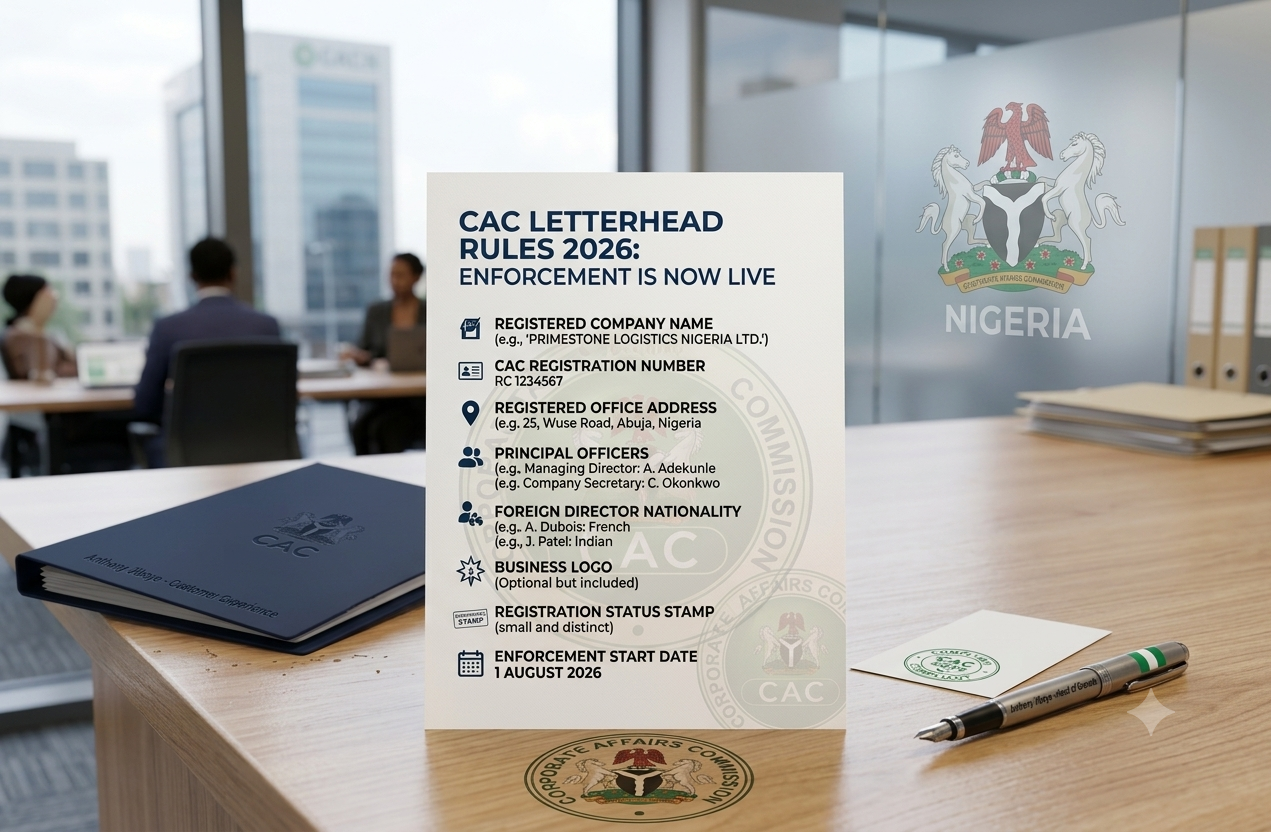
CAC Letterhead Requirements 2026 for Nigerian Businesses
Since 1 August 2026, the Corporate Affairs Commission has been actively enforcing a requirement that most Nigerian business owners never paid much attention to: what has to appear on your company’s letterhead. It sounds like a formatting detail. It is not. It is a statutory obligation under the Companies and Allied Matters Act (CAMA) 2020, and enforcement is no longer a future date on a notice, it is the reality businesses are now operating under.
What the CAC announced, and what has changed
By a public notice dated 7 July 2026, the CAC confirmed that from 1 August 2026 it would fully enforce Sections 304(1), 304(2) and 729(1)(c) of CAMA 2020. That date has now passed. These provisions require every registered company to display specific particulars on its business letters, trade circulars, and show cards:
• The company’s registered name
• Its registration number
• Its registered office address
• The present forename or initials and surname of every director (including any former name a director has used)
• The nationality of any director who is not Nigerian
This is not a new law. These requirements have existed in Nigerian company legislation for years. What has changed is enforcement. The CAC has passed the date it committed to, and Section 304(3) penalties now apply to both the company and any officer found in default.
Why a letterhead requirement is not as minor as it sounds
It is easy to dismiss this as paperwork trivia next to bigger issues like tax compliance or annual returns. But three things make it worth taking seriously, especially now that enforcement is active rather than pending.
First, it is easy to get wrong without realizing it. Many small and growing businesses design their letterheads once, early on, focused on logo and branding, and never revisit them as the company changes, directors join or leave, or the registered address moves. A letterhead that looked fine in 2022 may already be out of compliance today, and unlike before August 1, that gap now carries a live penalty rather than a theoretical one.
Second, this sits inside a broader pattern. The CAC has spent 2025 and 2026 tightening enforcement across the board, from mass strike-offs of companies with unfiled annual returns to closer database integration with the Federal Inland Revenue Service and the National Identity Management Commission. A regulator that follows through on a specific enforcement date, rather than letting it slide, is signaling how it intends to operate going forward, not just for this one requirement.
Third, the fix costs almost nothing, which makes the risk of leaving it unresolved hard to justify. Unlike a compliance gap that requires legal petitions or expensive restoration, this is a design and printing fix. A business that gets flagged for something this avoidable, after a clear notice period that closed weeks ago, will have a hard time arguing it did not have fair warning.
What to check now
With enforcement underway, every registered company in Nigeria should pull out its current letterhead, trade circulars, and any show cards used in business correspondence and check for five things:
1. Is the registered company name exactly as it appears on your CAC certificate, not a shortened trading name or old business name?
2. Is your CAC registration number printed and current?
3. Is your registered office address the one currently on file with the CAC, not an old office you have since moved from?
4. Are the full legal names of every current director listed, including any former names?
5. If any director is not a Nigerian citizen, is their nationality stated?
If any of these has changed in the last few years and your letterhead has not been updated to match, that gap is live now, not something to plan around for later. Every trade circular, show card, or business letter your company sends out while this remains unresolved is a fresh point of exposure.
The strategic point behind the compliance point
There is a broader lesson in this notice for SME owners, one that echoes what CAC’s other 2026 enforcement moves have signaled. Regulatory compliance in Nigeria is shifting from something that gets checked occasionally to something that gets monitored continuously and enforced on a schedule. A requirement that has technically existed for years can quietly become a live risk the moment a regulator decides to enforce it, and by the time most businesses hear about it, the enforcement date has often already arrived.
The practical response is straightforward: treat routine documents like letterheads, invoices, and official correspondence as part of your compliance surface, not just your brand identity. The businesses that build a habit of reviewing statutory disclosure requirements alongside their annual returns and tax filings will be the ones least likely to be caught out the next time a regulator draws a line in the sand, especially since, as this month has shown, that line does not stay in the future for long.
Disclaimer: This article reflects general commentary on a public regulatory notice and does not constitute legal advice. Business owners should verify the current requirements directly with the Corporate Affairs Commission (www.cac.gov.ng) and consult a qualified professional for guidance specific to their circumstances.

About the Author
Anthony Jiboye is the Head of Growth and Customer Experience at CreditPRO Finance Company Limited. With a proven track record in driving business expansion, customer retention strategies, and service excellence, Anthony leads CreditPRO’s growth initiatives to deliver seamless, customer-centric financial solutions. He is passionate about scaling innovative financial products, enhancing user journeys, and empowering businesses across Nigeria to access reliable funding and growth opportunities.