- September 16, 2026

Social Commerce is Becoming Nigera’s New SME Growth Engine: Approximately $2 Billion in GDP Through Social Media-based Sales
The report that Nigerian SMEs generated approximately $2 billion in GDP through social media-based sales is more than an encouraging statistic as it reflects a structural shift in how business is conducted in Nigeria.
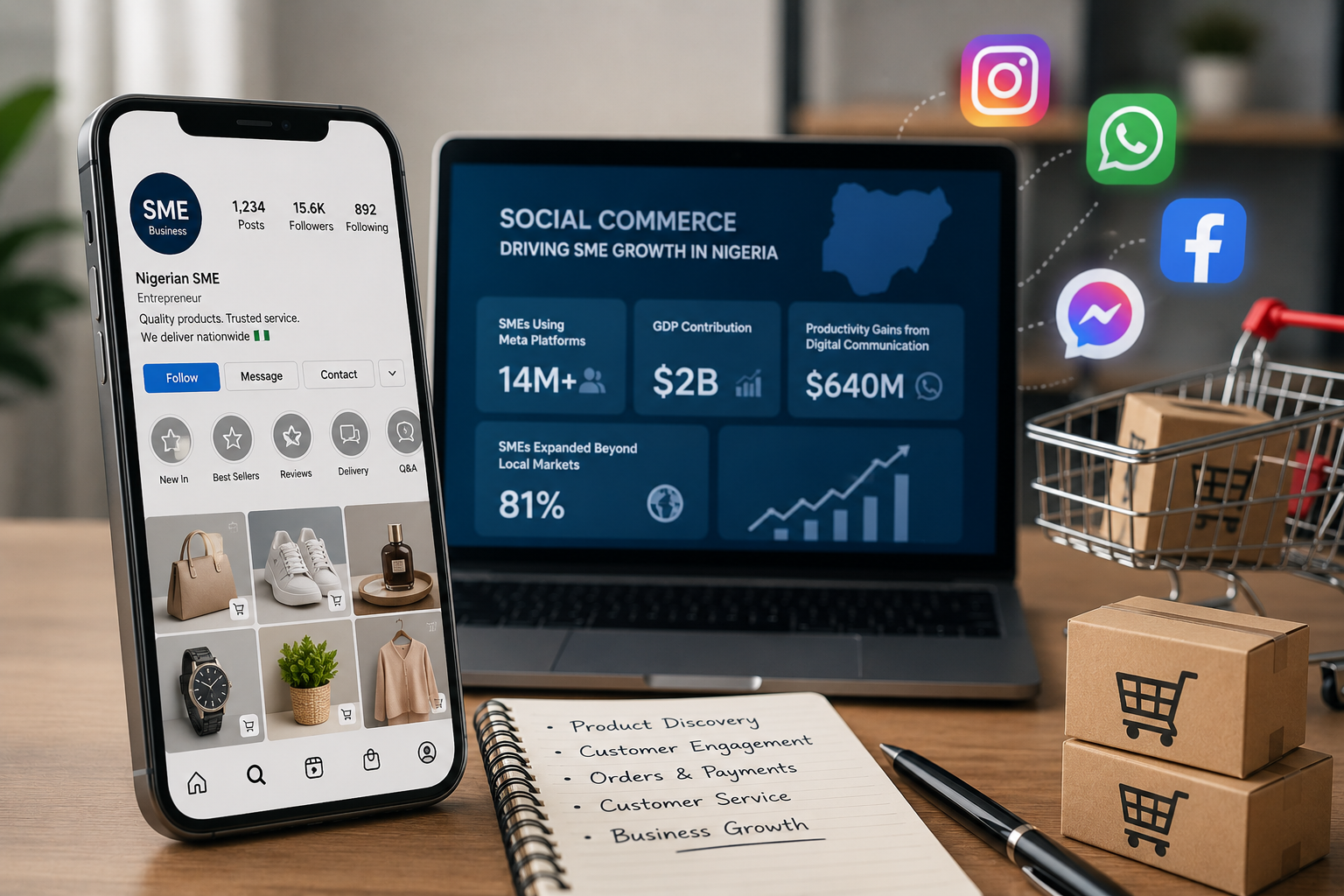
According to a recent public first report commissioned by Meta, about 14 million Nigerian SMEs used Meta’s platforms (Facebook, Instagram, WhatsApp, Messenger, Threads, and Meta AI) to establish, operate and grow their businesses. These businesses contributed an estimated $2 billion to Nigeria’s GDP and to be more specific, digital communication through instant messaging generated an additional $640 million in productivity gains. Furthermore, 81% of online businesses surveyed reported that Meta’s platforms helped them expand beyond their local markets.
This development from a strategic management perspective represents a fundamental transformation in Nigeria’s SME ecosystem. Social media has evolved far beyond being a marketing channel but it is increasingly functioning as a complete business infrastructure. Entrepreneurs now use these platforms for product discovery, customer acquisition, order processing, payments, customer service, and after sales engagement. Social media for many small businesses has effectively replaced the need for expensive physical stores and traditional advertising thereby significantly lowering barriers to market entry.
The implications for business growth are profound due to the reason that SMEs account for over 96% of businesses in Nigeria, employ approximately 84% of the workforce, and contribute more than 45% of the country’s GDP. Digital platforms therefore have the potential to amplify the productivity of a sector that already underpins Nigeria’s economy.
However, while the $2 billion contribution is commendable but it should be viewed as the beginning rather than the destination since many Nigerian SMEs still operate informally, lack robust digital strategies, and rely almost exclusively on organic social media visibility. Few have integrated customer relationship management systems, data analytics, inventory automation, digital advertising optimization, or artificial intelligence into their operations. Businesses that move beyond simply posting products online to building data driven digital commerce systems will be better positioned to achieve sustainable growth.
Although platforms such as Facebook, Instagram, WhatsApp, and TikTok provide unprecedented market access, SMEs remain vulnerable to algorithm changes, account restrictions, cybersecurity threats, and policy adjustments beyond their control. Therefore, another important consideration is the increasing dependence on third party platforms and it is advisable that smart businesses should therefore adopt an omnichannel strategy by combining social commerce with dedicated websites, email marketing, customer databases, and proprietary digital assets.
There is also a policy dimension to unlock the full economic potential of social commerce, investments in broadband infrastructure, digital literacy, cybersecurity, logistics, and affordable financing must accompany digital adoption. Regulators should consequently upsurge their innovation support while creating an environment that encourages secure digital transactions and consumer trust.
The message for entrepreneurs is clear which is, social media should no longer be viewed merely as a promotional tool but as a strategic business model. The businesses that will lead Nigeria’s next wave of economic growth are those that use digital platforms not only to sell products but also to build customer relationships, collect market intelligence, optimize operations, and continuously innovate.
The $2 billion milestone demonstrates what Nigerian SMEs have already achieved with digital tools but the far greater opportunity lies in transforming today’s social media sellers into tomorrow’s globally competitive digital enterprises.

About the Author
Dr. Ozemoya Osikpemhi Amos Onoshoze Pedro is an accounting and finance scholar, researcher, and professional with over a decade of industry experience. Holding a Ph.D. in Accounting and Finance, his expertise spans corporate finance, strategic management, governance, and business innovation. He is passionate about producing research that bridges academic theory with practical business solutions, helping organizations achieve sustainable growth and financial excellence. You can reach him on LinkedIn