- November 16, 2026

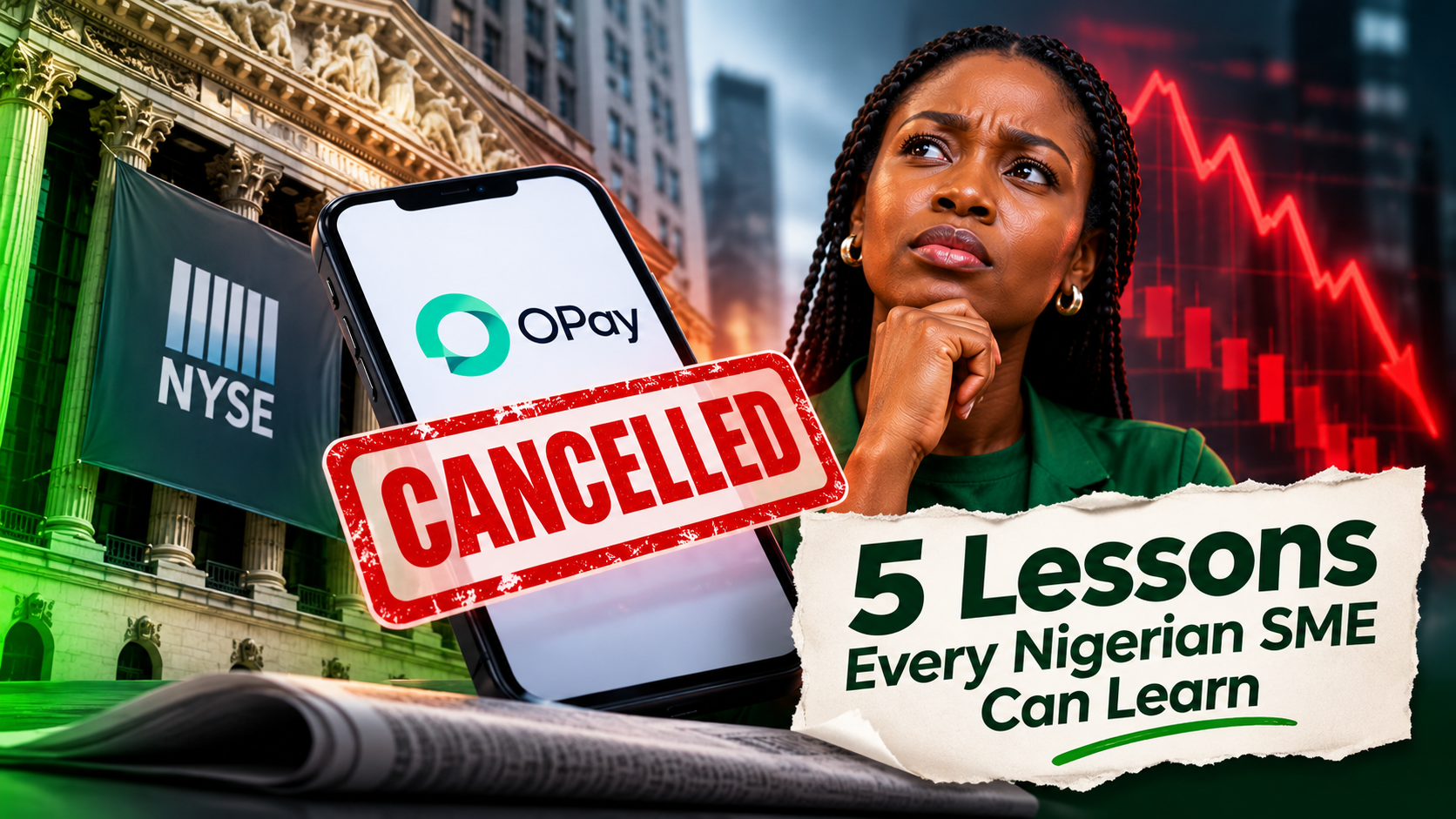
A $304 million share sale, a $4 billion valuation, zero shares traded. Here is what went wrong, in plain English, and what it means for your business.
OPay, the Singapore-headquartered fintech that serves millions of Nigerians, priced a New York Stock Exchange IPO on 30 October 2026 and then cancelled it before a single share traded.[1][2] The company blamed an inquiry by a regulator in a foreign jurisdiction, and Bloomberg later reported, citing unnamed sources, that the regulator is Chinese.[4] Nothing has been confirmed publicly. This article explains the story simply, separates facts from speculation, and shares five practical lessons on approvals, funding and communication that any Nigerian SME can use this week.
Imagine Amaka, who runs three fashion outlets, has spent months preparing a big expansion. The supplier is lined up, the shop leases are signed, and the celebration is booked. Then, on the morning of launch, one approval she assumed was fine suddenly raises questions, and everything stops.
That is roughly what just happened to one of Africa’s best-known fintechs, only with a few more zeros. The lessons, though, fit a market stall as well as a stock exchange. Let us walk through the story in plain English.
What Happened?
$304 million planned to be raised. About $4 billion implied value. Zero shares traded.[1][2][3]
The plan. OPay is a mobile money and payments company headquartered in Singapore, and
Nigeria is reported to be its largest market.[3] It planned to list on the New York Stock Exchange
(NYSE) under the ticker OPAY, selling 16 million shares, called American Depositary Shares (ADSs). The underwriting agreement, the contract between OPay and the banks organising the sale, is dated 29 October 2026.[2] The banks involved included Citigroup, Deutsche Bank and JPMorgan, and Standard Bank is also reported as an underwriter.[2][3][10]
The big day. On Friday 30 October the shares were priced at $19 each, the bottom of the $19 to $21 range the company had advertised.[1][3] The NYSE announced that morning that trading would begin, and one report even describes the company ringing the opening bell.[1][8] Then the trading never started.
The U-turn. On 31 October OPay said it was not proceeding “at this time” because of a regulatory inquiry in a foreign jurisdiction, and that it and the banks had agreed to terminate the underwriting agreement.[1][2] The company said the inquiry does not affect its services in Nigeria, Egypt, Indonesia or Pakistan, does not reflect on its business performance, and should be concluded satisfactorily in the near future.[1][2]
The China report. On 4 November, Bloomberg reported, citing people familiar with the matter, that the inquiry comes from a Chinese regulator.[4][9] OPay has not confirmed this, and the reports do not name the agency or say what it is asking about.[5][7] OPay reportedly has no operations or revenue in China.[4][6]
What we do not know. Whether the concern is about the listing, the founder, or something else is unclear, and the company says the matter is being handled “through the appropriate channels”.[2][7] We did not find a public statement from the Central Bank of Nigeria at the time of writing.
Update since we first wrote this (8 November). Four things have come out. First, OPay’s own prospectus reportedly told investors it could not assure them it would avoid Chinese filing requirements, even though its legal advisers had concluded none was needed.[10][11][13] Second, Standard Bank was reported to have planned a private investment of roughly $184 million to $200 million (outlets differ) that depended on the listing completing, so it is effectively on hold.[10][11] Third, a planned secondary listing on the Nigerian Exchange was to follow the US listing, so it appears to depend on it.[12] Fourth, we found no new OPay statement, no named regulator and no Nigerian regulator reaction.[11][13] For context, reports point to other recent cases where Beijing pressed companies with Chinese links, such as the unwinding of Meta’s Manus deal and a reported block on SoftBank’s $5.4 billion ABB robotics deal.[12][13] That is background, not proof of what is happening here.
OPay is not a distant company. Reports put it at more than 50 million monthly users, with Nigeria as its largest market (reported at about 89.5% of revenue),[1][3][11][13] so many Nigerian SMEs collect sales, pay suppliers or move money through it. Both the company and the reports we reviewed say services are running normally,[2][3] but anything that touches a platform your business depends on deserves your attention.
The story is also a masterclass in a simple truth: a business can look strong and still be stopped by a rule or approval it did not control. Reported figures show OPay’s first-half 2026 revenue jumped 137% to $467 million, with $91 million in net income,[3] and the shares were still pulled on listing day.
So is this about politics between China and the US? Possibly in the background, but that is not what the reporting shows. The reported regulator is Chinese, not American, and the US exchange and banks were ready to go.[1][4] Commentators note that China has tightened oversight of overseas listings and data security, and some warn that African fintechs with Chinese founders could face more scrutiny.[5] That is opinion and context, not a proven cause. Until the regulator or OPay says more, treat the geopolitical story as unconfirmed.
For founders, the practical point is this: you do not need to understand global politics to protect your business. You need to know which approvals, owners and partners your plans depend on.
Here are five lessons, each with something you can do this week.
OPay’s trouble reportedly traces to a link with a foreign jurisdiction, even though it has no operations there.[4][6] Take 30 minutes to list your owners, key investors, lenders, major suppliers and software or payment platforms, and note where each is based and what rules might follow them.
The shares were priced and ready, and the deal still stopped. Before you sign a lease, launch a product or announce a funding round, write down each approval you need (CAC, tax, sector regulator, bank, landlord, partner) and get it in writing. Notice that OPay’s prospectus had even flagged the filing risk in its small print.[11][13] Chase down the risks you spot in your own small print before they chase you.
Good numbers do not replace good documentation.[3] Keep your CAC filings, tax records, contracts and bank statements up to date and easy to find, so that when anyone asks a question, you can answer in a day, not a month.
Reports say the halt delays an important chance for investors, including SoftBank, to cash out.[5] If one door closes for a giant, imagine your small business with a single funder. Keep two or three options alive: a working capital line, invoice finance and customer prepayments.
OPay’s first message was to customers: services are running normally.[1][2] Copy that instinct. If something goes wrong in your business, tell customers, staff, suppliers and lenders what happened, what is unaffected, and what happens next, before rumours do it for you.
Make sure your ownership records are clear and current.
Local strength. OPay says Nigerian operations continue as normal,[2] and the episode may push more Nigerian businesses to compare payment partners, which can improve service and pricing for you.
A reason to tidy up. The best time to fix your records, ownership documents and approvals is before anyone asks. Businesses that do this move faster when opportunities appear.
Better funding choices. A plan with several funding options is more resilient and gives you better negotiating power. Banks, finance companies and development lenders each fit different needs.
A possible comeback. OPay says it expects the inquiry to be concluded soon.[1][2] If a listing returns later, it could open doors for Nigerian fintech investment. Nobody can promise that, so watch for official updates.
At CreditPRO, we see the small-business version of this story often: a good business, a great plan, and a missing document or a single funding source that causes delay at the worst time. The owners who sail through are usually not the biggest. They are the best prepared.
If you are planning growth, start with the numbers. Our loan calculator shows what a facility would cost you. Our loan offerings include business loans, LPO finance for confirmed purchase orders and invoice discounting to turn unpaid invoices into working cash. Our team is also happy to talk through your plans via the contact page. A good financial partner is one that helps you prepare, not just one that signs a cheque.
The OPay story is still unfolding, and much of it rests on unnamed sources, so we should stay careful about what we claim. What we can say with confidence is that a well-funded, fast-growing company priced its shares, rang the bell, and still did not get to trade.[1][2][8] Whatever the final explanation, the lesson for SMEs is timeless: know your dependencies, secure your approvals, keep your records spotless, spread your funding, and talk early.
Do one thing today. Write the names of your top five dependencies (platform, funder, supplier, regulator, key customer) on a page, and next to each one, write your Plan B. You will sleep better.
Trade”, 1 November 2026. https://startupfortune.com/opay–pulls–304–million–nyse–ipo–hoursbefore–shares–were–set–to–trade/
November 2026. https://businesspost.ng/economy/how–opay–halted–300m–us–ipo–after–chineseregulatory–inquiry/
November 2026. https://nairametrics.com/2026/11/05/chinese–regulatory–inquiry–forced–opay–tohalt–300–million–us–ipo–report/
November 2026 (credits Bloomberg and Semafor). https://thenextweb.com/news/opay-ipohalted-china-regulator-inquiry-zhou-yahui

About the Author
Anthony Jiboye is the Head of Growth and Customer Experience at CreditPRO Finance Company Limited. With a proven track record in driving business expansion, customer retention strategies, and service excellence, Anthony leads CreditPRO’s growth initiatives to deliver seamless, customer-centric financial solutions. He is passionate about scaling innovative financial products, enhancing user journeys, and empowering businesses across Nigeria to access reliable funding and growth opportunities.