- October 11, 2026

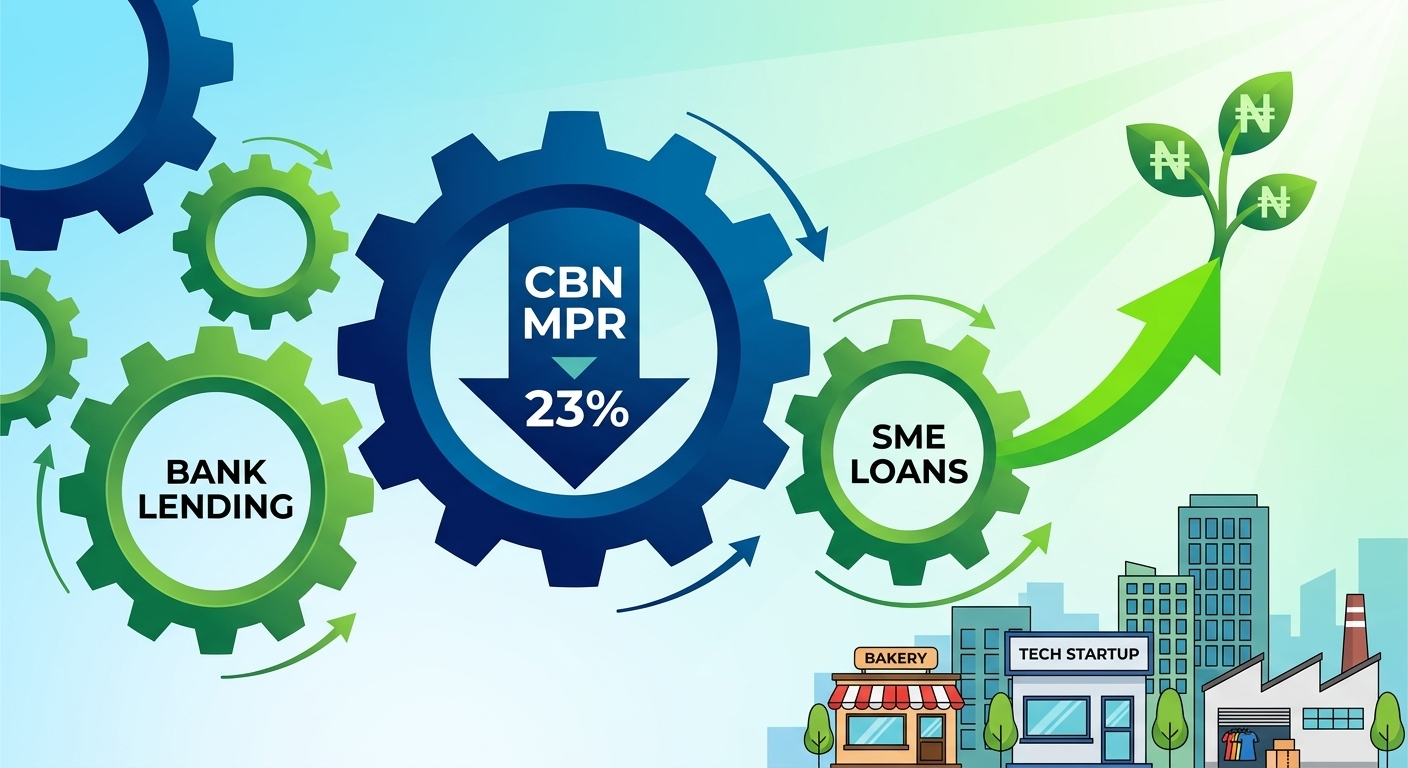
CBN Cuts MPR to 23%: Implications for SMEs in Nigeria
The Central Bank of Nigeria (CBN) has reduced the Monetary Policy Rate (MPR) from 26.5% to 23%, representing a 350 basis point cut at the Monetary Policy Committee’s meeting held on September 21–22, 2026. The CBN also adjusted the Standing Facilities Corridor to +50/-300 basis points around the MPR while retaining the Cash Reserve Requirement for deposit money banks at 45%.
The decision comes after the MPR was held at 26.5% in May and July following a 50 basis point reduction in February. The latest reduction is therefore a significant adjustment to the monetary policy framework. The CBN Governor, Olayemi Cardoso, described the move as a “reset and re-calibration” rather than a broad shift away from a restrictive monetary stance.
Why Did the CBN Cut the Rate?
The rate reduction comes against a backdrop of improving macroeconomic conditions as Nigeria’s headline inflation stood at 15.39% in August 2026 according to the National Bureau of Statistics while food inflation remained considerably higher at 19.57%.
The CBN has also pointed to improvements in foreign exchange conditions and broader economic activity as factors supporting the policy adjustment. The MPC reported stronger external buffers and continued economic growth thereby creating room to re-calibrate its policy rate signal.
What Does the 23% MPR Mean for SMEs?
The immediate question for SMEs in Nigeria is simple: Will this finally make business loans cheaper?
The answer is potentially, but not automatically.
A lower MPR can reduce the cost at which banks and other financial institutions obtain funds, creating room for lower lending rates. Cheaper financing could help SMEs fund working capital, inventory, machinery, expansion, technology and new projects.
Business organizations have already called for this transmission. One example is the Lagos Chamber of Commerce and Industry who has urged banks to pass the benefit of the MPR reduction to businesses particularly SMEs.
Therefore, the most important issue is not the 23% headline figure but whether the reduction reaches the real economy.
An MPR of 23% does not mean an SME can automatically borrow at 23% as commercial lending rates also reflect credit risk, operating costs, liquidity conditions, collateral, loan tenor and the individual borrower’s financial strength.
This concern is already being raised by industry stakeholders as the Manufacturers Association of Nigeria has warned that the rate cut could have limited impact if commercial lending rates remain around 30%, while Lagos Chamber of Commerce and Industry (LCCI) and the Centre for the Promotion of Private Enterprise (CPPE) have similarly stressed the need for effective transmission to borrowers.
For SMEs the opportunity is real but the benefit will depend on how financial institutions price credit after the policy change.
The Potential Impact on Nigerian SMEs
If lower policy rates translate into lower lending rates then SMEs could experience reduced financing costs and improved access to working capital and this could support increased production business expansion and employment among other benefits.
It could also improve the viability of projects that previously appeared uneconomic because of high borrowing costs. Manufacturers, distributors, retailers, agricultural businesses and service providers that rely heavily on short term credit could particularly benefit from lower financing expenses.
However, SMEs should not assume that every loan will become immediately cheaper but existing facilities may remain subject to their contractual terms while lenders will continue to assess the creditworthiness and risk profile of individual borrowers. Experts have also noted that transmission from the policy rate to actual borrowing costs may take time.
What SMEs Should Do Now
This is an appropriate time for businesses to review their financing strategy.
The Bigger Picture
The MPR reduction creates a potentially important opening for Nigeria’s private sector after a prolonged period of tight monetary conditions but the real test is whether cheaper monetary policy becomes cheaper productive credit.
For SMEs in Nigeria the message is clear which is prepare now for a potentially lower cost credit environment but continue to prioritize cash flow discipline, strong records and productive borrowing. The businesses best positioned to benefit will be those that can demonstrate exactly how additional finance will generate sustainable revenue and growth.

About the Author
Dr. Ozemoya Osikpemhi Amos Onoshoze Pedro is an accounting and finance scholar, researcher, and professional with over a decade of industry experience. Holding a Ph.D. in Accounting and Finance, his expertise spans corporate finance, strategic management, governance, and business innovation. He is passionate about producing research that bridges academic theory with practical business solutions, helping organizations achieve sustainable growth and financial excellence. You can reach him on LinkedIn