- September 16, 2026

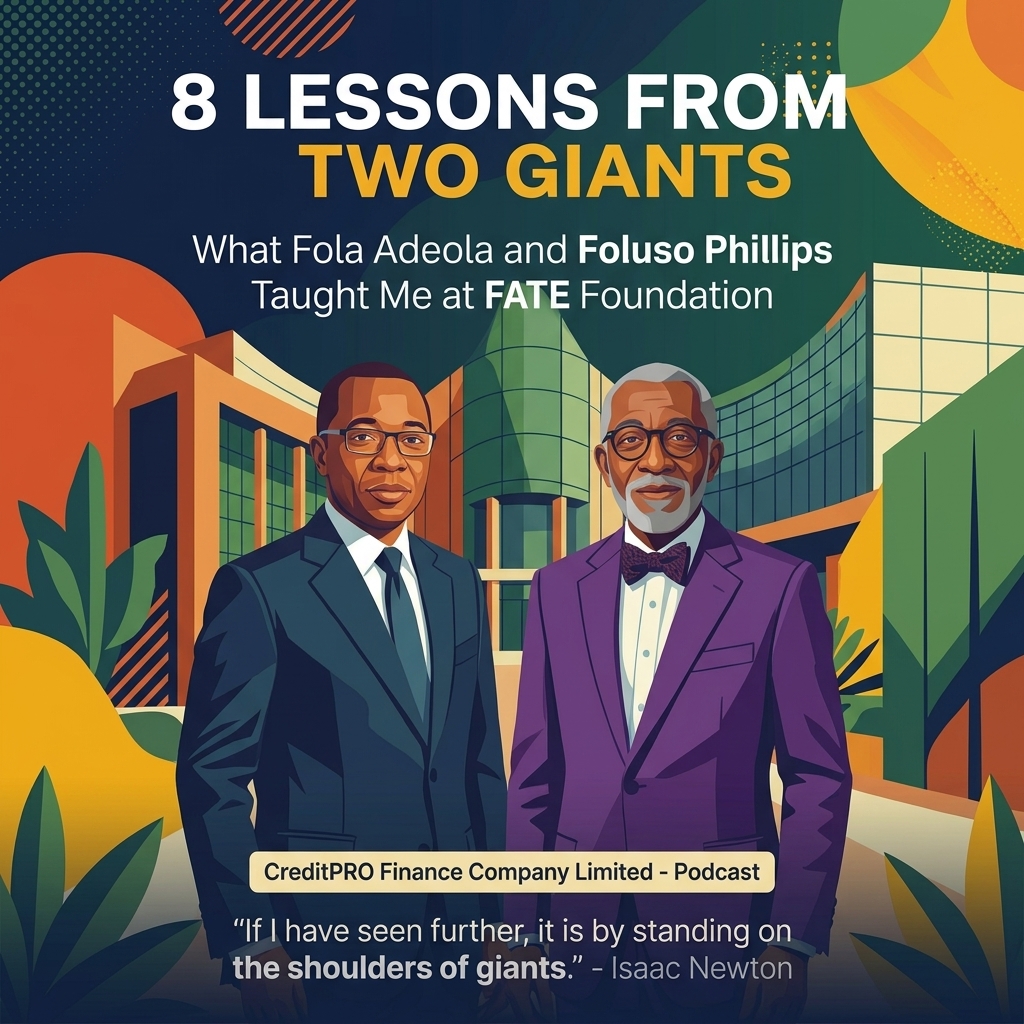
Eight Lessons From Two Giants: What Fola Adeola and Foluso Phillips Taught Me at FATE Foundation
“If I have seen further, it is by standing on the shoulders of giants.”
– Isaac Newton
Quick note before we go on: this article also comes with an 11-minute audio Deep Dive, the same eight lessons explored a little further, in an easy, relaxed conversation, like a good podcast. I’d genuinely encourage you to listen as well as read, it adds a layer of perspective the page alone doesn’t fully capture. Press play on the audio version at the top of this post, on your drive to work tomorrow, or a walk in the evening.
Earlier this year, CreditPRO Finance Company Limited was admitted into FATE Foundation’s Transformers Programme, a three-year initiative built for high-growth Nigerian businesses ready to scale beyond growth into lasting impact.[18] That admission is what placed me, personally, in the room on two separate occasions with two icons of Nigerian enterprise: Mr. Fola Adeola, co-founder of GTBank and founder of FATE Foundation itself, and Mr. Foluso Phillips, founder of Phillips Consulting. What follows are eight distinct lessons I personally took away, four from each man, explained in plain English, and, importantly, tested against decades of established global business thinking and real-world examples, from Kodak to Facebook to Nigeria’s own Paystack. These are my own interpretations of what I heard and understood, not verbatim quotes, but I believe every Nigerian entrepreneur will find something here worth applying this week.
I have sat in many business trainings. Most of them blur into each other after a while, PowerPoint slides, generic advice, a certificate at the end. But there are a few rooms you never forget, not because of the chairs or the catering, but because of who was standing at the front, speaking to you like your small business dream was worth their time.
That journey with FATE Foundation began when CreditPRO Finance Company Limited was admitted into the Foundation’s Transformers Programme, a three-year initiative under FATE’s 2024-2029 strategic plan, purpose-built for high-growth Nigerian businesses that have already found traction and now need structured support, mentorship, and capital access to scale into lasting impact.[18] It was through that programme that I found myself in two rooms, at different times, that I will not soon forget. In one, I met Mr. Fola Adeola, the man who co-founded GTBank, one of Nigeria’s most respected financial institutions, and who in the year 2000 turned his attention to a different kind of wealth creation: building people.[1][2] That is how FATE Foundation was born, a Foundation that has since worked with well over 250,000 Nigerian entrepreneurs.[5][6] He has been honoured nationally as an Officer of the Order of the Federal Republic and was appointed to the UK-led Commission for Africa, yet he sat with us and spoke, not as a legend lecturing beginners, but as a builder sharing hard-won scars.
In the other room, I met Mr. Foluso Phillips, the man who founded Phillips Consulting in 1992 and grew it into the largest indigenous management and business consulting firm in Nigeria, a firm that has since shaped strategy, leadership, and human capital decisions for some of the biggest organisations on the continent.[3] He is a chartered accountant and a chartered management accountant who today sits on boards, mentors executives, and speaks at global platforms from Harvard to Wharton.[3][4] Yet in the room with us, there was no airs, just a man determined to hand down what took him three decades to learn.
Both men gave their time, freely and generously, to sit with entrepreneurs who, on paper, had nothing to offer them in return. A quick, important disclaimer before I go further: everything below is my own personal interpretation of what I heard and took away from both sessions. It is not a verbatim transcript, and I do not claim that either gentleman would summarise his own advice exactly this way. It is simply how their words landed on me, and how I have since tried to apply them.
It would have been easy to leave those two rooms with a warm feeling and a few nice quotes for my Instagram caption. But the more I sat with what I had heard, the more I realised something important: these were not just personal anecdotes from two successful Nigerians. Nearly every lesson I took away lines up, almost word for word in some cases, with ideas that some of the most respected names in global management thinking have spent entire careers researching and writing about.
That matters, because it means these are not motivational one-liners that sound nice and fade by Monday. They are principles that have been tested across decades, across industries, and across companies far bigger than Phillips Consulting or GTBank, from Harvard Business School case studies to Silicon Valley boardrooms to roadside stalls in Lagos. Broadly, Mr. Phillips’s lessons speak to the internal architecture of a business, how it is built, structured, and perceived so that it can outlast its founder. Mr. Adeola’s lessons speak to strategic choice, what a business chooses to do, whom it chooses to serve, and, just as importantly, what and whom it deliberately walks away from. Below, I unpack all eight lessons individually, and for each one, I try to show you the real-world thinking and examples that back it up, so you don’t have to take my word, or even Mr. Adeola’s or Mr. Phillips’s word, alone.
Before the next four lessons, it’s worth pausing on something that can look confusing at first glance: Lessons 5 and 6 below can sound similar, but they are answering two completely different questions. Lesson 5, ‘strategy is what-not-to-do,’ is about which ACTIVITIES, projects, and opportunities your business says no to. Lesson 6, ‘the danger of wanting to satisfy everyone,’ is about which CUSTOMERS and market segments your business says no to. One is about what you do. The other is about who you do it for. Keeping that distinction clear is, in my own interpretation, exactly why Mr. Adeola presented them as two separate ideas rather than one.
I did not walk into these rooms by accident, and neither did the access to these two remarkable men happen by chance. It happened because FATE Foundation, quietly and consistently, has spent over two decades building a bridge between Nigeria’s most accomplished business minds and everyday entrepreneurs hungry to learn and grow.[5] Since its founding by Mr. Fola Adeola in 2000, the Foundation has trained well over a quarter of a million entrepreneurs across Nigeria, through structured programmes like the Aspiring Entrepreneurs Programme for those just starting out, and the Emerging Entrepreneurs Programme for established business owners ready to scale.[6][16][17] These are not one-off seminars, they are structured, months-long journeys of learning, mentorship, and accountability, delivered by people who have genuinely built what they teach.
For businesses that have already moved past the early stages and are pushing to scale further, FATE Foundation also runs the Transformers Programme, the very programme CreditPRO Finance Company Limited is proud to be part of. It is a three-year, more intensive engagement for high-growth Nigerian businesses, offering structured access to talent, mentorship, capital, and market opportunities tailored to each business’s specific scaling needs, as part of FATE’s stated ambition to help create 10,000 jobs by 2030 through the businesses it supports.[18] I mention our own admission not to advertise CreditPRO, but because it is the clearest proof I can offer that this ecosystem is not just theory to us, we are walking through it ourselves, and the value has been real. If you are running a business in Nigeria today, whether it is a small shop, a growing company just past its early stage, or just an idea you are nursing, a FATE Foundation cohort, at whichever stage fits you, is, without question, one of the most transformative decisions you can make for yourself and your business this year.
At CreditPRO, we see the fingerprints of these exact eight lessons on the SME clients who go on to grow sustainably. The businesses that impress us most are rarely the loudest, they are the ones with documented processes that don’t collapse when the owner travels, a clearly defined customer they can describe in one sentence, and the discipline to say no to opportunities that don’t fit. That kind of clarity doesn’t just make a business easier to run, it makes a business easier to finance, because it is easier for a lender to understand exactly what we are backing and why. If Mr. Adeola’s and Mr. Phillips’s lessons resonate with you as they did with me, know that building that clarity is also, quietly, one of the best things you can do for your access to responsible, sustainable financing.
Eight lessons, two rooms, two generous men who didn’t have to show up but did anyway. If there is one thread that runs through everything Mr. Phillips and Mr. Adeola shared, as I have come to understand it, it is this: lasting businesses are built with intention, not accident. They are built by people willing to document what’s in their head, say no more often than they say yes, know precisely who they serve and who they don’t, and care as much about how the business runs without them as how it runs with them. I am grateful to have sat, even briefly, in the presence of these two icons of Nigerian enterprise, and I want to be clear one final time: the eight lessons above are my own interpretation and application of what I heard, not a transcript of their words. I hope that sharing them, validated against real business thinking and real companies, will inspire a few more entrepreneurs reading this to seek out a room like that for themselves, starting, perhaps, with a FATE Foundation cohort.
[1] Nairametrics, “Everything you need to know about Fola Adeola, Co-founder, GTBank Plc.” https://nairametrics.com/2020/07/17/everything-you-need-to-know-about-fola-adeola-co-founder-gtbank-plc/
[2] Wikipedia, “Fola Adeola.” https://en.wikipedia.org/wiki/Fola_Adeola
[3] Businessday NG, “Meet Foluso Phillips, the economist who built a consulting institution and never stopped believing in people.” https://businessday.ng/life-arts/article/meet-foluso-phillips-the-economist-who-built-a-consulting-institution-and-never-stopped-believing-in-people/
[4] DAWN Commission, “Foluso Phillips: Building Institutions That Outlive Their Founders.” https://dawncommission.org/foluso-phillips-building-institutions-that-outlive-their-founders/
[5] FATE Foundation, “About.” https://fatefoundation.org/about/
[6] Businessday NG, “FATE Foundation trains 256,277 entrepreneurs in 26 years.” https://businessday.ng/markets/article/fate-foundation-trains-256277-entrepreneurs-in-26-years/
[7] Michael Porter, “What Is Strategy?” Harvard Business Review, 1996. https://hbr.org/1996/11/what-is-strategy
[8] Theodore Levitt, “Marketing Myopia,” Harvard Business Review Classics. https://store.hbr.org/product/marketing-myopia-harvard-business-review-classics/2601
[9] Forbes, “How Kodak Failed.” https://www.forbes.com/sites/chunkamui/2012/01/18/how-kodak-failed/
[10] Michael E. Gerber, “The E-Myth Revisited: Why Most Small Businesses Don’t Work and What to Do About It.” https://www.barnesandnoble.com/w/the-e-myth-revisited-michael-e-gerber/1100249444
[11] Harvard Magazine, “How Facebook Escaped Harvard.” https://www.harvardmagazine.com/technology/harvard-facebook-history-mark-zuckerberg-winklevoss
[12] HistoryLink.org, “Amazon: The Early Years (1995-1999).” https://www.historylink.org/File/23230
[13] Al Ries, “Positioning: The Battle for Your Mind.” https://www.alries.com/positioning
[14] Lenny’s Newsletter, “Geoffrey Moore on finding your beachhead, crossing the chasm, and dominating a market.” https://www.lennysnewsletter.com/p/geoffrey-moore-on-finding-your-beachhead
[15] Today Africa, “Inside Paystack’s Journey: From Lagos Startup to a $200M Stripe Acquisition.” https://todayafrica.co/inside-paystacks-journey/
[16] The FATE School, “Aspiring Entrepreneurs Programme (AEP).” https://thefateschool.org/aep/
[17] The FATE School, “Emerging Entrepreneurs Programme (EEP).” https://thefateschool.org/eep/[18] The FATE School, “The FATE Transformers Programme.” https://thefateschool.org/transformersprogram/
About the Author
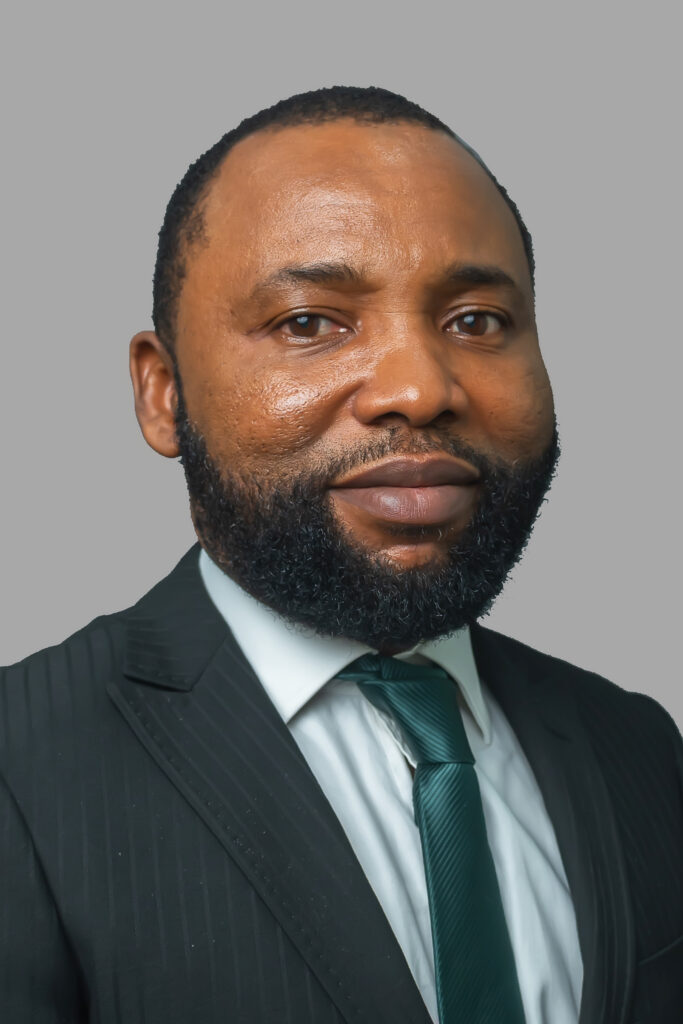
Anthony Jiboye is the Head of Growth and Customer Experience at CreditPRO Finance Company Limited. With a proven track record in driving business expansion, customer retention strategies, and service excellence, Anthony leads CreditPRO’s growth initiatives to deliver seamless, customer-centric financial solutions. He is passionate about scaling innovative financial products, enhancing user journeys, and empowering businesses across Nigeria to access reliable funding and growth opportunities.