- September 16, 2026

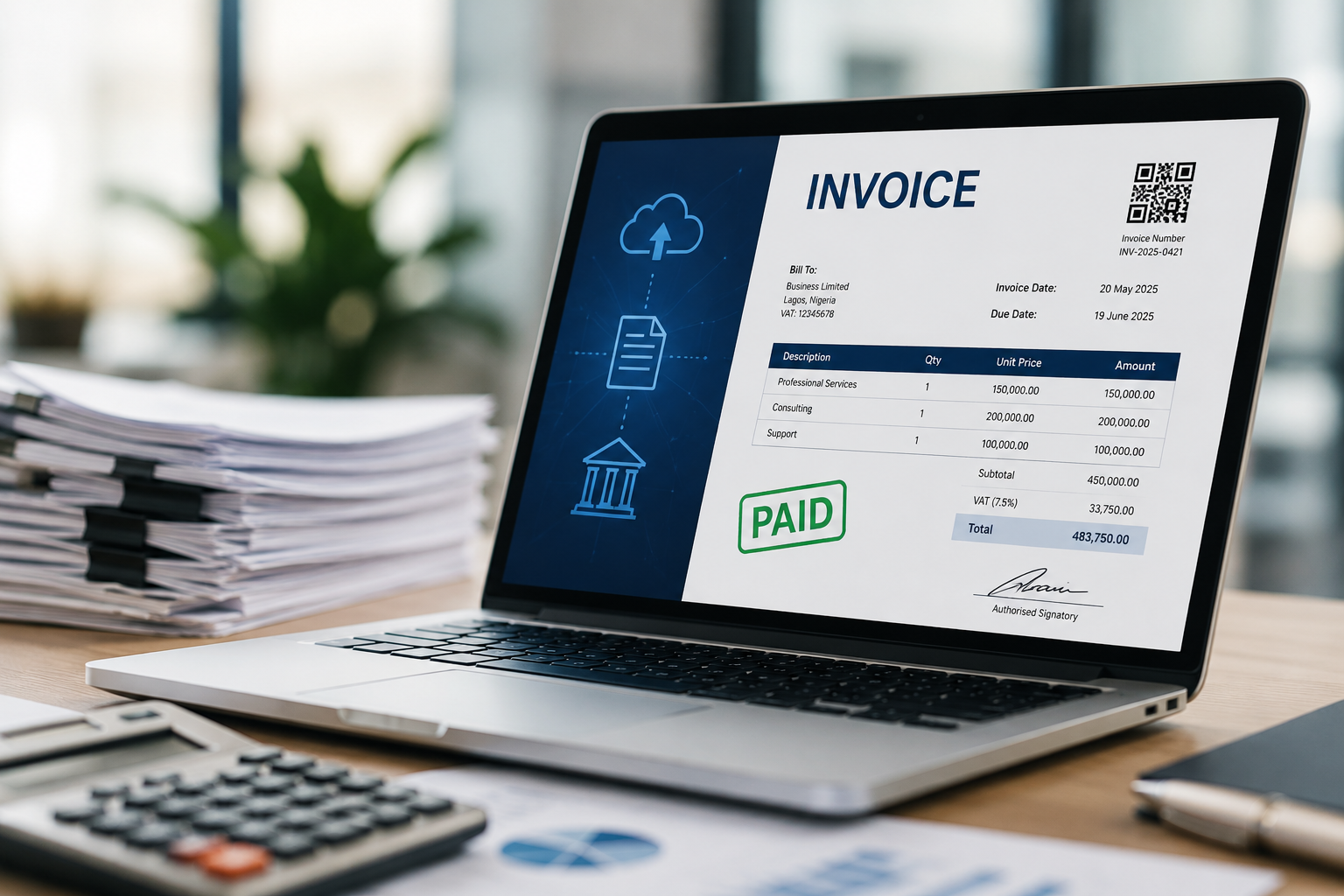
Nigeria E-Invoicing Rule 2026: What It Means for SMEs and Suppliers
Your Big Customers Are Going Digital on Invoices. Here’s Why That Should Matter to You.
The government has a new rule about how businesses send invoices. It is called e-invoicing, and big companies in Nigeria now have to follow it. The deadline for them is July 31, 2026. If you run a small or medium business, you might think this has nothing to do with you. But if you sell anything to a big company, it does. Here is why, explained simply, and in a bit more depth than the usual headline.
What is e-invoicing?
Normally, when you sell something to a business, you send them an invoice. It might be a Word document, an Excel sheet, or even a handwritten receipt. Under the new system, big companies now have to send their invoices through a government platform called the Merchant Buyer Solution before the sale counts for tax purposes. The platform checks the invoice, structures the information in the right format, and gives it a special code called an Invoice Reference Number. Without that code, the invoice is treated as if it does not officially exist, even though everyone knows the sale happened.
Why should a small business care? The VAT explanation, simply put
This is the part that actually makes the rule bite, so it is worth slowing down on.
VAT is the tax added on top of most goods and services. Here is how it normally works between two businesses. Say your business sells goods to a bigger company. They pay you the price plus VAT. Later, when that bigger company files its own taxes, it does not hand over all the VAT it collected from its own customers. It first subtracts the VAT it already paid to suppliers like you. This subtraction is called an input VAT credit, and it is money the big company gets to keep rather than send to government. Under the new rule, the big company can only subtract that VAT if your invoice went through the government platform and received the special code. If your invoice did not go through the system, the big company cannot
claim that credit. They end up paying VAT twice in effect, once to you and once again with no way to recover it. This is why the rule has real teeth. It is not just a compliance box to tick. It directly reduces how much money your big customer keeps on every transaction with you, unless your invoice is properly processed.
What this means for how big companies will treat suppliers
Put yourself in the shoes of a big company buying from many small suppliers. If buying from one supplier quietly costs you extra money in unclaimed VAT, and buying from another does not, which one do you keep working with? Over time, expect big buyers to:
•Ask suppliers directly whether they can issue system compliant invoices
•Favour suppliers who already can, even if the difference in price or quality is small
•Push back on payment terms, delay payments, or ask for a discount to cover their own VAT loss when
dealing with non compliant suppliers
•Eventually stop buying from suppliers who consistently create this extra cost
None of this requires a new law aimed at small businesses. It happens naturally because the incentive has shifted for the buyer.
There is also a penalty for the businesses directly mandated
For the large companies required to comply right now, there is a real cost for missing the deadline. Any VAT tied to an invoice that was not properly transmitted can be treated as a fine, and it collects interest at 2 percent above the Central Bank’s benchmark rate, which currently sits at 26.5 percent. That works out to nearly 29 percent interest on unpaid amounts. This is a big part of why large companies are moving quickly, and why they will start pushing this pressure down to their suppliers soon, if they have not already.
The timeline, and why the gap matters most for SMEs
•Large companies (turnover above 5 billion naira): required to be compliant now, with enforcement from July31, 2026
•Medium sized companies (turnover between 1 billion and 5 billion naira): began joining the system from July 2026, with enforcement starting January 2027
•Smaller businesses (turnover below 1 billion naira): have until 2027 to join, with enforcement only starting in 2028
Look closely at that gap. Most SMEs will not be legally required to comply for another year or two, or longer. But if your biggest customers fall into the first two categories, they are already inside the system or entering it very soon. The commercial pressure from your customers will arrive long before your own legal deadline does. Waiting for your own enforcement date to worry about this misses the point entirely.
Why joining the system is not simple, even when you are ready
This is not just about ticking a box. To issue a compliant invoice, your accounting or invoicing setup needs to be able to structure the data correctly and connect to the government platform, either directly or through an approved technology partner. Many small businesses in Nigeria still invoice through spreadsheets, notebooks, or basic templates, which are not built to plug into a system like this. Getting ready usually means upgrading how you keep records, not just changing a form. This is exactly why a small but growing number of technology providers now specialise in connecting older accounting setups to the government’s e-invoicing infrastructure without forcing a business to overhaul everything from scratch. If your systems are behind, you are not alone, and there are simpler paths to catching up than doing it all in house.
What you can do about it, starting now
1.Ask your biggest customers directly. Will they need you to send system compliant invoices soon, and by
when? Most will tell you if you ask.
2.Get an honest read on your current setup. Talk to your accountant about how far your invoicing and
bookkeeping are from being able to join the system.
3.Start early, not later. Preparing ahead of time is far cheaper and easier than scrambling after you have
already lost a major customer.
4.Clean up your financial records generally. Good, organised records make this transition easier, and they
also strengthen your position when you apply for financing
The bottom line
This rule was written for big companies, but small businesses will feel its effects through the customers they depend on most. The businesses that prepare early will protect their biggest relationships. The ones that wait may find those relationships slipping to competitors who moved first.
At CreditPRO, we work closely with SMEs on their financing needs, and we can point you toward trusted experts who specialise in tax and invoicing compliance if you need help getting your systems ready for this shift.
Not sure where your business stands on this? Reach out to the CreditPRO team, we are happy to talk it through with you

About the Author
Anthony Jiboye is the Head of Growth and Customer Experience at CreditPRO Finance Company Limited. With a proven track record in driving business expansion, customer retention strategies, and service excellence, Anthony leads CreditPRO’s growth initiatives to deliver seamless, customer-centric financial solutions. He is passionate about scaling innovative financial products, enhancing user journeys, and empowering businesses across Nigeria to access reliable funding and growth opportunities.