- September 22, 2026

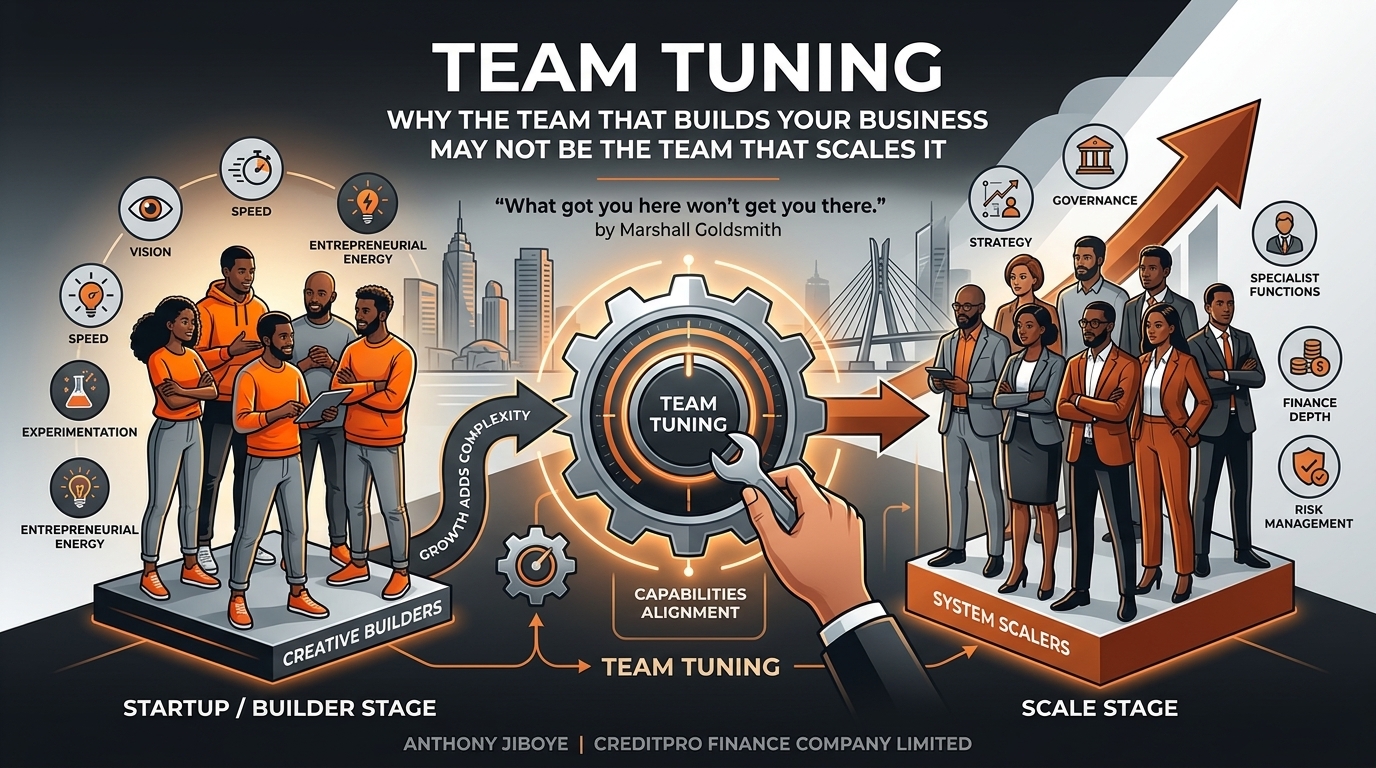
Team Tuning: Why the Team That Builds Your Business May Not Be the Team That Scales It
“What got you here won’t get you there.” – Marshall Goldsmith
Quick note before we dive in: This article also comes with an audio Deep Dive, where we take the conversation a little further—exploring why the team that builds your business may not be the same team that scales it, how founder dependency can become a growth constraint, and the practical signs that your business may have outgrown its current structure. It’s an easy, relaxed listen that adds another layer of perspective to the conversation around building teams that can grow with the business.
Ask any founder who has taken a business from an idea to real scale.
They will tell you the same story.
The people who started the business are rarely the same.
They take it to the next level.
This pattern also reflects SME leadership team scaling Nigeria for growth.
Venture capitalist Fred Wilson captured this idea in a line from a serial entrepreneur.
He said you will turn your team three times on the way from startup to a business of scale.
Wilson has been closely involved with more than 150 startups.
Roughly a third of them reached real scale.
Should you take the number three literally? Probably not. There is no rule in entrepreneurship that says a business must reshuffle its leadership exactly three times. What research does support is something more useful and more universal: as a business grows, its structure, its leadership roles and the capabilities it needs all evolve, and the team has to evolve with them. We call this Team Tuning, and for Nigerian, African and global SMEs alike, understanding it early can be the difference between a business that plateaus and one that scales.
What Is Team Tuning?
Team Tuning is the continuous process of adjusting a company’s people, leadership roles, capabilities and structure so that they stay aligned with where the business is today, and where it needs to be next.
It does not necessarily mean firing anyone. Sometimes it means hiring. Sometimes it means redefining a role. Sometimes it means moving an existing employee into a position where their strengths are better used. And sometimes, yes, it means recognizing that someone who was exactly right for an earlier stage of the business may not be right for the stage the business has now grown into.
The question at the center of Team Tuning is not “do we have good people.” It is: do we have the right team for the business we are today, and for the business we are trying to become?
In the earliest stages of a business, structure often matters less than speed. The founder is usually selling, experimenting, fixing problems, building relationships and improvising, sometimes all in the same week. What matters is proving the idea can work at all.
Yet traction raises the question. When a business wins customers consistently, the real test is repeating it. Can it scale further without the founder handling every detail? Growth adds complexity that is easy to underestimate. More customers mean more processes. More employees mean more management layers. More transactions require stronger controls. More capital brings greater accountability to providers. At some point, the founder cannot personally supervise every decision. The business then needs deeper capability in finance, operations, technology, risk, people management, sales, and governance. This dynamic highlights SME leadership team scaling Nigeria as a growth challenge.
This is not just an entrepreneur’s intuition. A 2017 meta-analysis of 55 studies and nearly 8,900 observations found a link between leadership team composition and performance. This highlights SME leadership team scaling Nigeria in practice. In plain terms, who is around the table matters. But what matters at one stage of a business is not necessarily what matters at the next.
Separately, research on what scholars call top management team “misfit” looked specifically at the gap between the roles a growing venture actually needs and the qualifications of the people currently occupying them.[2] The finding is worth sitting with: sometimes the problem is not that the people are bad. The problem is that the organization around them has changed. A person who was highly effective when the company had fifteen employees may genuinely struggle when it has a hundred and fifty, not because they became worse at their job, but because the job itself quietly became a different job.
Rather than count exact turnovers, it is more useful for entrepreneurs to think in terms of capability stages, since research on scaling ventures shows that organizing and growth tend to evolve together rather than in one clean jump.[4]
Team Tuning is not something a company does once at a single milestone. It is a continuous discipline that runs through every one of these stages.
Consider Adeola Foods Limited, a fictional Nigerian food-processing and distribution business.
When Adeola Foods started, annual turnover was around ₦100 million.
The founder was involved in nearly everything: negotiating with suppliers, winning customers, approving payments, and supervising staff.
This approach worked because the business was still simple enough for one person to hold in their head.
This case shows SME leadership team scaling Nigeria in practice.
A few years later, turnover approached ₦1 billion. On paper, that looked like nothing but good news. In practice, the business had changed: more customers, more suppliers, more employees, larger working-capital needs, more inventory, larger receivables and far greater exposure to operational and financial risk. The founder could no longer personally supervise everything, and the real question shifted from “can we run this business” to “can we run this business at this scale without losing control.”
Three changes supported SME leadership team scaling Nigeria.
First, the company hired a stronger finance professional.
A ₦1 billion business needs sharper cash-flow forecasting, working-capital management, budgeting, and cost control.
Second, as orders grew, the founder still approved many decisions, so the operations function gained clearer processes.
Third, with larger commitments, internal controls and risk management strengthened to address cash-flow, credit, and fraud exposure.
None of this meant the original team was bad. At ₦100 million, the founder’s hands-on involvement was an advantage. At ₦1 billion, that same level of founder dependence had become a constraint. The business had not failed; it had simply become a different business, and it needed a different team to match. This pattern is not unique to Nigeria, and it is not limited to fast-growing fin-techs. It shows up in food processing, logistics, retail, manufacturing and services businesses across Nigeria, and across Africa, wherever a business crosses from one stage of complexity into the next.
It is tempting to assume Team Tuning is only a concern for small, growing businesses. It is not. In late 2023, Flutterwave, one of Africa’s most prominent fin-techs, brought in six senior executives in a single wave, including a new Chief Risk Officer with a background at Citibank, Bank of
America, Stripe and PayPal, and specialists in compliance and global expansion drawn from Cash App, Binance.US and Wyre.[5] The move followed the departure of three finance executives the previous month, and came shortly after the company began pursuing money-transfer licenses across multiple US states.[5] Chief executive Olugbenga Agboola described the goal plainly as helping the company sustain its growth, with the incoming team bringing more than a hundred years of combined experience in financial services.[5]
The lesson for a growing Nigerian SME is not “hire from Silicon Valley.” It is that even a company operating at Flutterwave’s scale recognized that the capabilities needed to expand into new, more regulated markets were not automatically the same capabilities that built the company in the first place, and it tuned its team accordingly, deliberately and visibly, rather than waiting for a crisis to force the issue.
Perhaps the most useful discipline for any founder, whether running a ₦50 million business or a multinational one, is to periodically ask: is my team still fit for purpose, both for the business we are today and the business we are trying to become?
This matters more, not less, in the Nigerian context. A 2026 report from Meristem Family Office found that 40% of respondents identified excessive founder reliance as a major threat to business continuity, while only 20% of the family businesses surveyed had a documented succession plan in place.[6] Founders, the report noted, tend to concentrate key relationships, commercial knowledge, decision-making authority and institutional memory in themselves, which creates real organizational vulnerability whenever a transition, planned or unplanned, eventually arrives.[6] Separately, PwC’s MSME survey work in Nigeria continues to flag inadequate skilled labor as a structural constraint on business growth.[7] Taken together, these findings suggest that many Nigerian SMEs are more exposed to the risks of an untuned team than their founders may realize.
Warning signs that a business has outgrown its current team include decisions taking too long to reach, founders becoming bottlenecks for approvals that should not need them, managers operating outside their real areas of competence, too much responsibility concentrated in one person, customer experience becoming inconsistent as volume grows, and promising opportunities being missed simply because no one in the organization has the capacity to chase them. None of these are necessarily signs that people are failing. More often, they are signs that the business has moved into a new stage before its team has caught up.
Businesses that get ahead of Team Tuning, rather than reacting to it, tend to compound two advantages at once. First, they reduce single points of failure earlier, which makes them more attractive to lenders, investors and larger corporate customers who are, quite reasonably, wary of businesses that depend entirely on one person. Second, they free up the founder to spend more time on the decisions only a founder can make, such as strategy, key relationships and where the business goes next, rather than on operational decisions a well-built team should be handling. For Nigerian SMEs specifically, formalizing governance and building management depth ahead of a funding round, a bank facility, or a bigger contract can be the difference between qualifying for that opportunity and missing it entirely.
At CreditPRO, we see this pattern often: a business is ready to grow and has already identified the finance lead, operations manager or risk officer it needs to hire, but is hesitant to commit to the higher payroll cost before the growth it is chasing has actually materialized. This is precisely the gap our Payroll Finance Facility exists to close, giving qualifying businesses access to up to 70% of a month’s payroll costs in advance, so that building the right team does not have to wait for cash flow to catch up with ambition. In our experience, the businesses that grow sustainably are rarely the ones with the most capital. They are the ones whose team, capital and ambition are aligned at every stage.
There is no rule that says your business must change its leadership exactly three times, or at any fixed number, on its way to scale. But there is a pattern worth taking seriously: the team that is right for one stage of a business is not automatically the team that is right for the next one, and recognizing that early, rather than waiting for the business to force the point, is a genuine competitive advantage.
Every entrepreneur should periodically ask a simple question: if I were building this company from scratch today, knowing everything I now know about its size, complexity and ambitions, would I design the team exactly the way it looks right now? If the honest answer is no, that is not a failure. It usually just means the business has grown. And when a business grows, sooner or later, the team has to grow with it.
[1] Fred Wilson, “From The Archives: Turning Your Team,” AVC, 2017.
https://avc.com/2017/01/from-the-archives-turning-your-team/
[2] Ferguson, A. J., Cohen, L. E., Burton, M. D., & Beckman, C. M., “Misfit and Milestones:
Structural Elaboration and Capability Reinforcement in the Evolution of Entrepreneurial Top
Management Teams,” Academy of Management Journal. https://journals.aom.org/doi/10.5465/amj.2014.0526
[3] Jin, L., Madison, K., Kraiczy, N. D., Kellermanns, F. W., Crook, T. R., & Xi, J., “Entrepreneurial
Team Composition Characteristics and New Venture Performance: A Meta-Analysis,”
Entrepreneurship Theory and Practice, 2017. https://journals.sagepub.com/doi/abs/10.1111/etap.12232
[4] DeSantola, A., & Gulati, R., “Scaling: Organizing and Growth in Entrepreneurial Ventures,”
Academy of Management Annals. https://journals.aom.org/doi/abs/10.5465/annals.2015.0125
[5] Techpoint Africa, “Flutterwave Hires 6 New Executives from Cash App, PayPal, Binance.US, Others.” https://techpoint.africa/news/flutterwave-hires-from-cash-app-paypal/
[6] Nairametrics, “Meristem Family Office Report Highlights Succession, Founder Dependence as
Key Risks to Family Wealth Continuity,” 24 June 2026.
https://nairametrics.com/2026/06/24/meristem-family-office-report-highlights-successionfounder-dependence-as-key-risks-to-family-wealth-continuity/
[7] PwC Nigeria, MSME Survey 2024. https://www.pwc.com/ng/en/press-room/pwc-msmesurvey-2024.html

About the Author
Anthony Jiboye is the Head of Growth and Customer Experience at CreditPRO Finance Company Limited. With a proven track record in driving business expansion, customer retention strategies, and service excellence, Anthony leads CreditPRO’s growth initiatives to deliver seamless, customer-centric financial solutions. He is passionate about scaling innovative financial products, enhancing user journeys, and empowering businesses across Nigeria to access reliable funding and growth opportunities.